

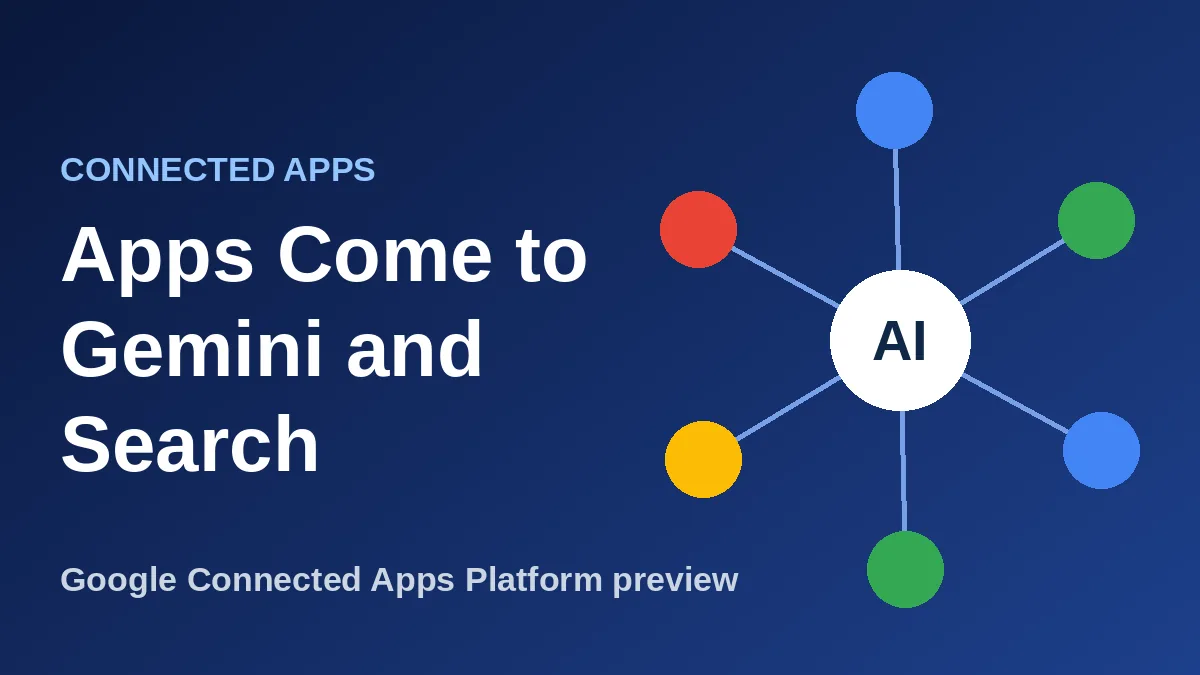
The Google Connected Apps Platform is now in preview, and it lets developers build one integration that works inside both the Gemini app and Google Search. For you as a user, it means more apps will let you finish a task, like ordering groceries or starting a playlist, without leaving the chat or the search page.
Google announced it on October 28, 2026. Access is limited for now, so most developers will have to apply and wait.
Here are the facts worth knowing before we get into the details.
- Announced October 28, 2026 as a preview, with access opening in phases.
- One integration reaches the Gemini app, AI Mode in Search, or both.
- Developers connect through a remote MCP server or Android AppFunctions.
- Google says more than 50 Connected Apps have already launched.
- Adobe, Experian, Localiza and Peloton are live in Gemini; Search is “coming weeks.”
The short version: this is Google’s answer to the app directory idea, built on an open standard instead of a custom plugin format.
What the Connected Apps Platform actually does
Think of it as a doorway. A company registers its app once, and Google makes that app’s tools available where people already ask questions. You link your account one time, then the assistant can pull your data or take actions for you.
Google’s own examples are simple ones, such as ordering groceries and making playlists. The help pages for Search and Gemini list the apps you can use today.
Before an app goes through review, its developer picks where it should appear: Search, Gemini, or both. That choice matters, because Search is where the biggest audience sits.
Two ways to connect: MCP server or Android AppFunctions
| Path | What you build | Where it runs | Best for |
|---|---|---|---|
| Remote MCP server | Tools and data exposed over the Model Context Protocol; optional interactive UI with MCP Apps | Your cloud | Web services, accounts, orders, subscriptions |
| Android MCP (AppFunctions) | Functions your Android app shares with agents like Gemini through the Jetpack AppFunctions SDK | On the user’s device | Apps that need local execution |
Both routes use MCP, the same protocol we covered in our Safari MCP server guide. If you’ve followed how AI agents plug into tools, this will feel familiar.
The remote MCP path suits anything that lives on a server. The AppFunctions path keeps the work on the phone, which can be better when data shouldn’t leave the device.
How developers register, test and submit
Google points developers to a tool called Google Connected Console. It handles the whole flow, from signing up to going live.
- Apply for the preview through the application form.
- Register your tools in the console and test them.
- Choose Search, Gemini, or both, then submit for review.
- After launch, watch traffic, latency and error rates.
Google says developers keep control of their brand, including verified logos and authenticated accounts. Sign-in uses OAuth 2.1, and Google has a separate guide for it.
The docs don’t list detailed requirements or testing steps yet, and the announcement says nothing about pricing or revenue terms. Expect that to be the first question every product team asks.
Which Connected Apps work right now
Adobe, Experian, Localiza and Peloton are live for Gemini users. Google says they will reach Search “in the coming weeks,” so don’t expect them there today.
Calm is the new addition, coming to both Search and Gemini. Google hasn’t given a launch date for it.
This lines up with a bigger shift in Search. We recently looked at Google AI Mode ads going global, and apps that can act inside AI answers are the natural next piece of that product.
What this means for you as a user
Nothing changes until an app you use joins. When one does, you’ll see a prompt to link your account, and after that you can ask the assistant to do things in plain language.
Before you link anything, check what the app can access. A connected app can read account data, so treat the permission screen like you would for any other sign-in.
Google says access will grow to more developers, markets and Google products over the coming months. If your country isn’t covered yet, that’s likely why.
Frequently Asked Questions
Is the Google Connected Apps Platform available to everyone?
No. It’s a preview with phased access, and developers have to apply. Google says it will add developers, markets and products over the coming months.
Do I need to install anything to use Connected Apps?
No. You link your account to the app from inside Gemini or Search. Which apps are available depends on your region and the app’s rollout.
What is MCP in simple terms?
MCP, the Model Context Protocol, is a shared standard that lets AI assistants call tools and read data from other services. It means one integration can work with many assistants.
Will it cost developers anything?
Google hasn’t said. The announcement and docs don’t mention pricing or revenue terms.
Our take
This is a sensible move, and betting on MCP instead of a closed plugin format should make life easier for developers. The catch is that Google hasn’t shared pricing, review rules or how apps get ranked in Search, and those details decide whether small developers benefit or only big brands do. If you build apps, apply now and watch the terms closely; if you’re a regular user, wait for an app you already trust to show up rather than linking accounts just to try it.
Leave a Reply