

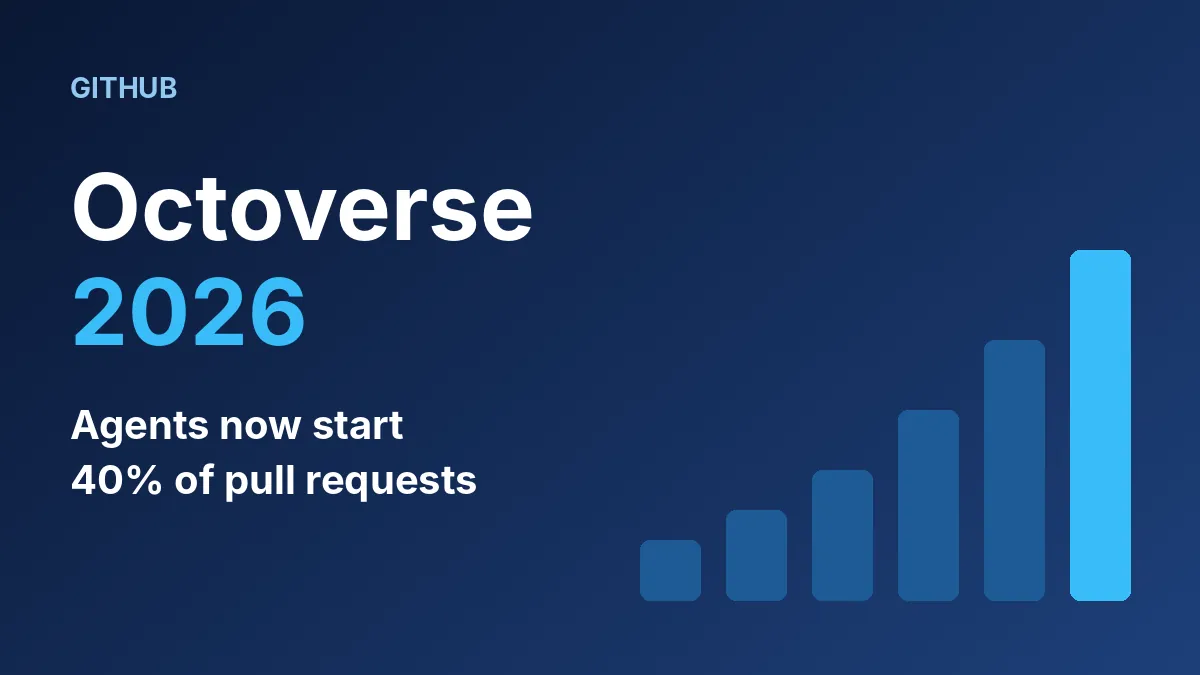
GitHub Octoverse 2026 landed on October 28, and the headline is hard to miss: developers now start more than 40% of pull requests with an AI agent. That was 17% in March. The report also shows GitHub’s activity jumping to levels the platform has never seen.
Here’s what the numbers say, what they don’t, and what they mean if you write code for a living.
Quick Facts
- Published October 28, 2026, covering October 1, 2025 to September 30, 2026.
- Agents started more than 40% of pull requests in September, about 110 million of them.
- GitHub now has more than 225 million developers.
- Commits hit 34.3 billion, over three times the 2024 level.
- TypeScript is the top language by contributors, ahead of Python and JavaScript.
Those five lines are the story. The rest of this post explains why they matter.
Is GitHub Really Growing That Fast?
Yes, and the jump is steep. GitHub says commits grew about 6x between September 2025 and September 2026 on a monthly basis. Pushes grew about 4.5x, and merged pull requests about 3.9x.
The yearly totals tell the same story. Each number below comes from the official report.
| Metric | 2024 | 2025 | 2026 |
|---|---|---|---|
| Pushes | 5.2 billion | 6.7 billion | 17.9 billion |
| Commits | 10.0 billion | 12.9 billion | 34.3 billion |
| Merged pull requests | 402 million | 538 million | 1.3 billion |
| GitHub Actions jobs | Not stated | 14.0 billion | 45.4 billion |
Pushes alone now exceed 2024 and 2025 combined. GitHub also says about 55% of commits since June came from brand-new repositories, which hints at lots of fresh projects rather than just busier old ones.
How Agents Changed Pull Requests
Agent-started pull requests went from 17% in March to over 40% in September. That’s roughly six times the volume in six months.
These aren’t tiny fixes, either. According to the report, 87% of agent-started pull requests touch multiple files, compared with 79% for the rest. And 90% of agent-involved pull requests were merged within two weeks, up from 83% in February.
That last point answers a common worry. If reviewers were rejecting agent code in droves, the merge rate wouldn’t be climbing. GitHub’s own caveat is blunter: someone still has to decide whether the code works and belongs.
Copilot usage backs this up. 55% of monthly active Copilot users now use agentic features, up from 35% a year ago. If you want the model-routing side of that story, we covered how GitHub Copilot Fusion picks the model for you.
Which Programming Languages Lead in 2026?
TypeScript holds first place by contributors, with Python second and JavaScript third. TypeScript added 3.62 million monthly contributors over the year, Python 3.23 million, and JavaScript 1.82 million.
Rust is the one to watch. GitHub calls it the fastest-growing top language by percentage, having doubled in a year.
AI involvement also varies a lot by language, as the table shows.
| Language | Share of merged PRs with AI involvement |
|---|---|
| TypeScript | 44.1% |
| Python | 41.1% |
| Rust | 40.4% |
| Java | 21.2% |
Java sits well below the others. The report doesn’t explain why, so treat any theory (older codebases, stricter enterprise review) as a guess.
Where Developers Are, and Who Is Building
The United States leads with 38.3 million developers, followed by India at 32.0 million and China at 12.4 million. Both the US and India added more than 10 million developers in the past year.
The industry data is more surprising. Public repositories grew from 9.0 million in 2022 to 25 million in 2026, and construction has the highest share of repos with agent-opened pull requests, at about 9%. In mining, health care, agriculture, and administrative services, over 40% of repos mention AI, yet agent pull requests stay under 3%.
In plain terms, talking about AI and shipping with agents are very different things outside software companies.
What GitHub Octoverse 2026 Means for Your Own Code
If you review code, expect more of it, and expect more of it to be agent-written. Repos created this year with an agent configuration file logged eight times as many commits as those without one, so the tooling clearly changes how people work.
GitHub also reports that AI-assisted code review and GitHub Advanced Security usage each grew more than 90%. Push protection ran 5.8 billion scans, nearly four times last year’s pace. More code means more places for secrets and bugs to slip in, so those tools matter.
Our piece on building coding agents with the Cursor Agent SDK shows how easy it is now to wire an agent into a workflow.
One note on sources: Simon Willison’s write-up gives monthly rates of about 220 million merged pull requests and 7.38 billion commits, which are monthly rates from a different time window than GitHub’s yearly totals. Check which one you’re quoting.
Frequently Asked Questions
What is GitHub Octoverse?
It’s GitHub’s yearly report on how developers use the platform. The 2026 edition covers October 1, 2025 to September 30, 2026 and includes public and private repositories unless noted.
How many pull requests do AI agents start?
More than 40% as of September 2026, according to GitHub. That’s about 110 million pull requests in that month alone.
How many developers are on GitHub now?
More than 225 million. The US has 38.3 million and India 32.0 million, the two largest groups.
What is the most popular language on GitHub?
TypeScript, by number of contributors. Python is second and JavaScript third.
Does more AI code mean worse code?
The report doesn’t say so. Agent-involved pull requests were merged at a 90% two-week rate, but merge speed isn’t the same as quality, so human review still counts.
The Takeaway
The data says agents are no longer a side experiment. If you’re a developer, learn to review agent-written changes quickly and set up secret scanning and code review before your repo fills up. If you manage a team, the bottleneck is moving from writing code to checking it, and that’s where your time should go next.
Leave a Reply