

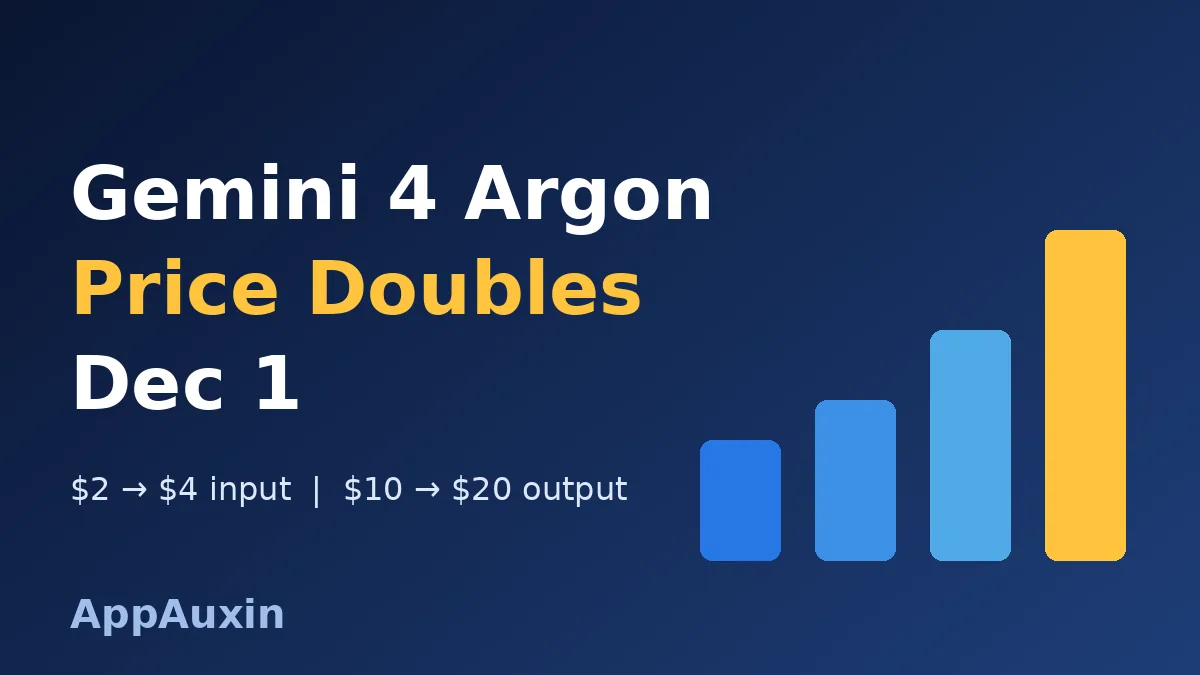
The Gemini 4 Argon pricing you see today is a launch discount, and it ends on November 30. From December 1, API rates double to $4 per million input tokens and $20 per million output tokens.
If you built something on Argon this month, your bill will double on that date unless you change something. Here’s what that means and what you can do about it.
Quick facts before we get into the details:
- Launch: Google made Argon globally available on October 13, 2026.
- Intro price: $2 input and $10 output per million tokens, through November 30.
- Standard price: $4 input and $20 output per million tokens, starting December 1.
- Context window: about 1 million tokens.
- Access: paid Gemini API only. The free tier doesn’t include it.
That’s the whole story in five lines. The rest of this post covers what the doubling costs in practice.
What changes on December 1
Nothing about the model changes. Same Argon, same context window, same API. Only the per-token rate moves.
Both rates double, so there’s no workload that escapes it. Input-heavy jobs like summarizing long documents and output-heavy jobs like code generation each pay twice as much.
Here’s the same pricing in plain numbers. These figures come from the rates reported by BuildMVPFast and Let’s Data Science, which match each other.
| Rate per 1M tokens | Intro (to Nov 30) | Standard (from Dec 1) |
|---|---|---|
| Input | $2 | $4 |
| Output | $10 | $20 |
What Gemini 4 Argon pricing means for your bill
Per-million prices are hard to feel. A quick example helps: a small app that sends 10 million input tokens and gets back 2 million output tokens in a month pays $40 now and $80 after the switch.
Here are a few usage levels side by side, using the rates above.
| Usage (monthly) | Through Nov 30 | From Dec 1 |
|---|---|---|
| 10M input + 2M output tokens | $40 | $80 |
| 50M input + 10M output tokens | $200 | $400 |
| 200M input + 40M output tokens | $800 | $1,600 |
The gap grows fast with volume. A team running 200 million input tokens a month goes from $800 to $1,600, and that’s before any retries or long-context requests.
How Argon compares with Claude on price
Once the discount ends, Argon lands at the same list price as a premium rival. According to Let’s Data Science, Claude Opus 5.5 lists at $4 input and $20 output per million tokens.
So the pricing edge Argon has today is temporary. After December 1, you’ll choose based on quality and fit for your task, not on a lower rate.
That matters if you’re comparing models for a new project. Price the December numbers, not the November ones. If you’re also weighing OpenAI’s newer models, our look at GPT-6.1 Terra’s pricing covers that side.
Five ways to soften the jump
You can’t avoid the new rate, but you can use fewer tokens. These steps work for most apps.
- Trim your prompts. Long system prompts get billed on every call, so cut anything the model doesn’t need.
- Cap output length. Output tokens cost five times as much as input, so a max-token limit protects your budget.
- Route easy tasks to a cheaper model. Save Argon for the hard requests. GitHub Copilot Fusion uses this same idea to pick models automatically.
- Cache repeated context where your setup supports it, instead of resending it.
- Set a budget alert in your Google Cloud billing so December doesn’t surprise you.
The biggest win is usually routing. Many apps send every request to their best model when most requests don’t need it.
Who can use Argon, and who should look elsewhere
Argon is on the paid Gemini API, in Google AI Studio, and in the Gemini app for Pro and Ultra subscribers, based on the reports above. It isn’t available on the free API tier.
If you only use Argon through the Gemini app, nothing changes for you. The price change hits developers who pay per token.
Not sure which Google model line you’re on? Our post on Gemini 4 Carbon explains how it differs from Argon and why it’s limited to cyber defenders for now.
Frequently Asked Questions
When does Gemini 4 Argon pricing go up?
On December 1, 2026. The introductory rates of $2 input and $10 output per million tokens end on November 30.
Is Gemini 4 Argon free to use?
Not through the API. It needs the paid tier. In the Gemini app, it’s available to Pro and Ultra subscribers.
Will the Gemini app price change too?
The reports we found only cover API pricing. Subscription prices weren’t mentioned, so check Google’s plan page for your own account.
How big is the Argon context window?
About 1 million tokens, or 1,048,576 to be exact. That fits very long documents or large codebases in a single request.
Should I lock in usage before November 30?
You can’t lock in the rate, since it applies per token when you use it. But you can run heavy batch jobs and testing before December 1 to pay the lower price.
Our take
Treat the current price as a trial rate, not the real one. Build your budget on $4 and $20, run your big experiments before December, and test whether a cheaper model handles your easy requests. If Argon still earns its place at double the cost, keep it. If not, you’ll know before the bill arrives.
Leave a Reply