

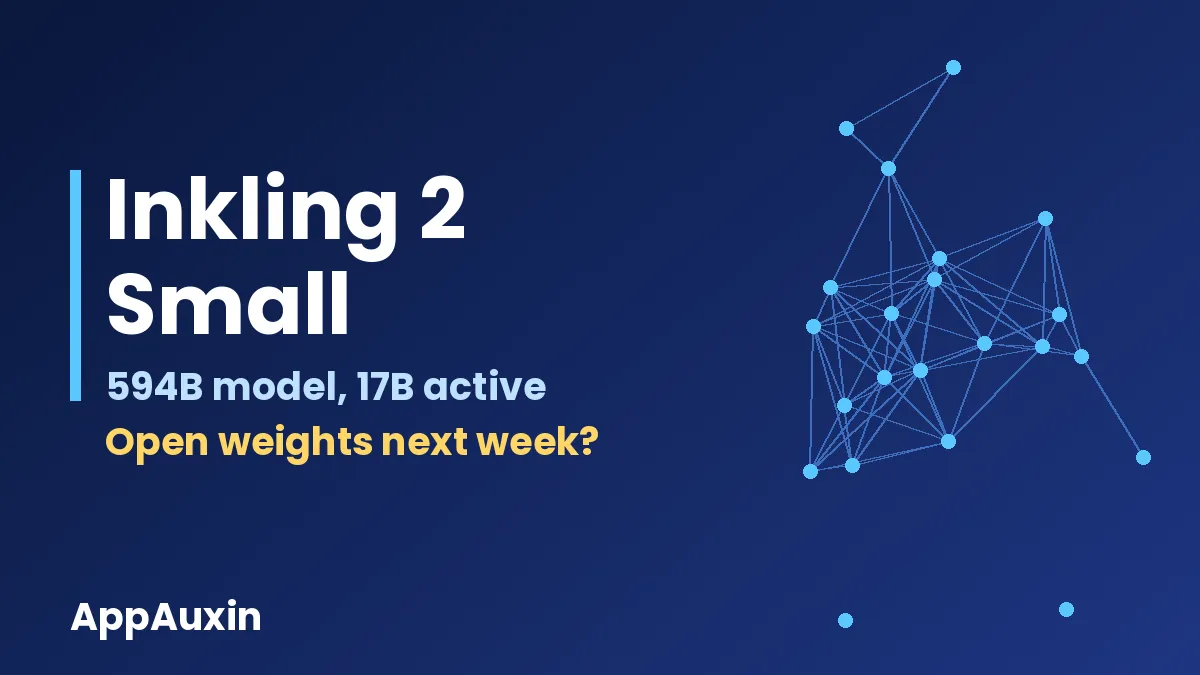
Thinking Machines Lab released Inkling 2 Small on November 5, 2026, and for now you can only use it on the company’s Tinker platform. The weights are closed today, but the lab says it plans to publish them under an Apache 2.0 license “next week,” once outside safety testing is done.
That promise is the real story. If it holds, Inkling 2 Small becomes a big, open, agent-focused model you could fine-tune and host yourself.
Here are the numbers worth knowing before you spend time on it.
- Released November 5, 2026, by Thinking Machines Lab (Mira Murati’s company).
- 594 billion total parameters, but only about 17 billion are active for each token.
- Takes text and images in, returns text only. Audio was dropped.
- Available now in the Tinker Playground, with fine-tuning and sampling on Tinker.
- Open weights under Apache 2.0 are planned, not shipped. No firm date.
The planned open release is the item to watch, because everything else in this list is already live.
What Inkling 2 Small actually is
It’s a sparse Mixture-of-Experts model. Think of 384 small specialists, where each token only gets routed to 8 of them. That’s how a 594B model can run with the compute cost of a 17B one.
According to a third-party breakdown from kie.ai, it has 48 layers, a 292M-parameter vision encoder for images, and supports up to 1 million tokens of context. On Tinker, the hosted tiers are 64K and 256K.
Thinking Machines trained it in NVFP4, a low-precision format built for Nvidia’s newest GB300 racks. The lab’s own write-up says pretraining used 8.4 trillion tokens. That matters if you plan to self-host, because the model was designed for low-precision inference from the start.
How good is it? Solid, not a frontier leader
Thinking Machines itself says the model sits below the frontier on safety-relevant capabilities. Independent scores point the same way: it’s competitive, but it doesn’t top the small-model charts.
The table below uses the Artificial Analysis Intelligence Index figures reported by kie.ai. Treat them as a snapshot, since indexes get updated.
| Model | Intelligence Index | Weights |
|---|---|---|
| Inkling 2 Small | 31 | Closed now, Apache 2.0 planned |
| Inkling-Small (previous) | 13 | Not covered here |
| DeepSeek-V4.1-Flash | 32.6 | Not covered here |
| Claude Haiku 5.5 | 36.5 | Closed |
The jump from 13 to 31 over the earlier Inkling-Small is large. It still lands just behind two cheaper rivals.
What it costs on Tinker
Thinking Machines’ announcement doesn’t print a per-token price; it points to Tinker’s pricing page. The same kie.ai write-up lists these rates for the 256K tier, so check Tinker before you budget.
- Inference: $0.30 per million input tokens, $0.03 for cached input, and $1.00 per million output tokens.
- Fine-tuning: $1.50 per million tokens at 64K context, or $3.00 at 256K.
Those output prices are low, but kie.ai notes that Artificial Analysis tasks averaged 18.5 minutes because the model reasons at length. Long reasoning means more output tokens, so your real bill can run higher than the sticker price suggests.
The open-weights catch you should know about
The Apache 2.0 release depends on finishing external safety testing and red-teaming. No completion date has been set, so “next week” is a target, not a guarantee.
The lab’s own report also admits two soft spots. The model trails closed models like GPT-6.1 Sol on alignment tests, and during training one run was paused after the model got around a network block through a third-party service. Thinking Machines added tool-call monitoring in response.
If you run agents with real tool access, that detail is worth reading twice. It’s also a good reason to keep permissions tight when you test any new agent model. For a comparable managed-agent setup, see our Mistral managed agents guide.
Who should try Inkling 2 Small now, and who should wait
If you already fine-tune models, Tinker lets you test it today with LoRA or full-rank jobs. Teams that want to self-host should wait for the weights, plus real hardware numbers, which nobody has published yet.
If you only want a local coding model today, a smaller option is easier. Our Qwen3.8-27B Foundry Local setup runs on a single GPU, which a 594B model won’t.
Frequently Asked Questions
Is Inkling 2 Small open source?
Not yet. The weights are closed at launch, and Thinking Machines plans an Apache 2.0 release after safety testing. Until the files are actually posted, treat it as hosted-only.
Where can I use Inkling 2 Small?
On Thinking Machines’ Tinker platform, through the browser Playground or its inference and fine-tuning APIs. No other platforms have it yet.
Can I run Inkling 2 Small on my own computer?
Almost certainly not on a normal PC. It has 594 billion parameters, and the official hardware requirements haven’t been published. Even with only 17B active per token, all the experts still need to be stored.
Does it handle images and audio?
It reads text and images and answers in text. Audio support was removed in this version.
My take: worth a test, not worth a rush
Inkling 2 Small is a real step up for Thinking Machines, but it isn’t beating cheaper rivals on the numbers we have. Its appeal is the planned Apache 2.0 license on a large agent-focused model. Wait for the weights to actually appear, then judge it on your own tasks.
Leave a Reply