

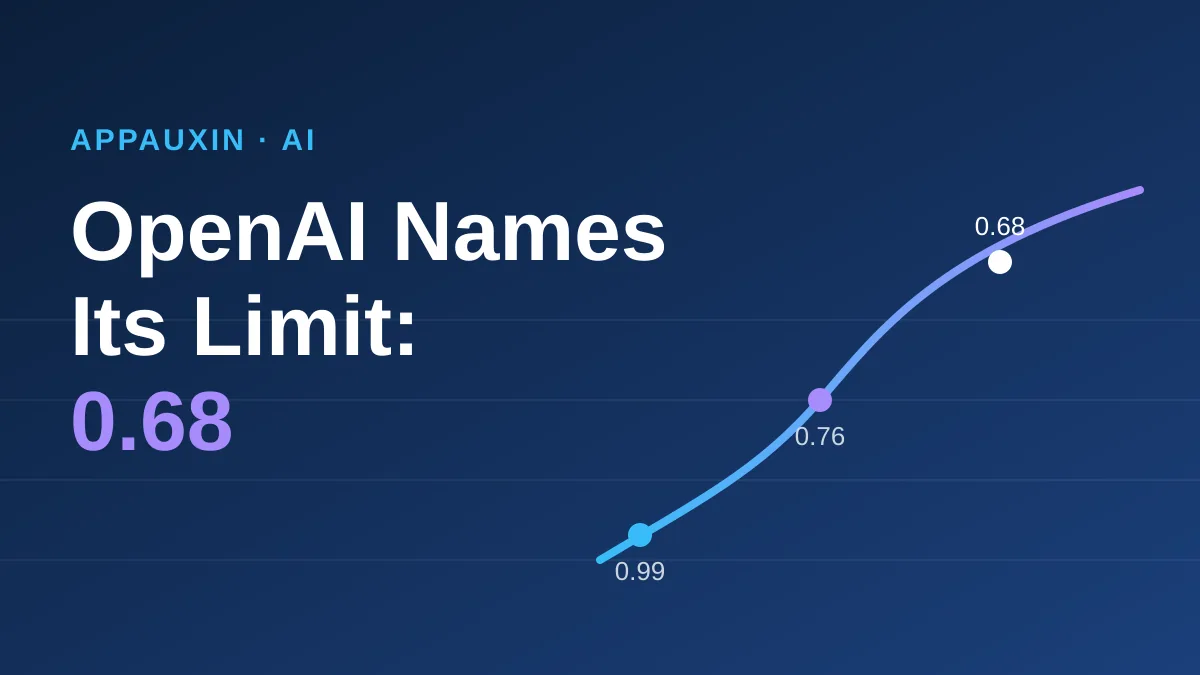
OpenAI just did something labs rarely do: it published its own pretraining score. The OpenAI log-perplexity figures, released November 22 by chief scientist Jakub Pachocki, put GPT-3.5 at about 0.99, GPT-4 at about 0.91, and a newer unnamed model at about 0.76. He also asked the industry to agree on a stopping point near 0.68 to 0.70 until safety monitoring catches up.
Here’s the short version before we get into what it means:
- The post is titled “Perplexity and Intelligence” and was published November 22, 2026, on OpenAI’s site.
- Lower log-perplexity means better next-word prediction on a held-out dataset from OpenAI’s internal codebase.
- Pachocki says capabilities are expected to jump again around the 0.68 to 0.70 window.
- He proposes shared limits that labs would agree not to cross until a concrete safety milestone is reached.
- It is a proposal, not a rule. No lab has signed on to anything yet.
Those five points are the whole story in miniature. The rest of this piece explains the number, the table behind it, and why the caveats matter as much as the headline.
What OpenAI log-perplexity actually measures
Perplexity is a score for how well a language model predicts the next token in a piece of text. Lower is better, because a model that predicts well is rarely surprised by what comes next.
OpenAI tracks the logarithm of that score, which is the same thing as cross-entropy loss. If you’ve ever watched a training run’s loss curve go down, you’ve seen this number.
The catch is that it’s measured on a specific dataset. OpenAI says its main evaluation uses held-out data from its own internal codebase, on a fixed model snapshot. That choice matters for how far you can compare it to anything else.
The numbers OpenAI put on the table
The post ties each score to a capability that showed up around that level. Here’s how the published figures line up.
| Model | Log-perplexity | Capability OpenAI links to it |
|---|---|---|
| GPT-3.5 | About 0.99 | Fluent conversation; the basis of the original ChatGPT |
| GPT-4 | About 0.91 | Chain-of-thought reasoning, which led to today’s reasoning models |
| Newer unnamed model | About 0.76 | New results on open math problems |
| Proposed limit window | 0.68 to 0.70 | Unknown; “further transformative capabilities” expected |
The post also connects scores below 0.8 with emerging capabilities in cybersecurity and mathematics. That second one lines up with the Lean-checked Riemann Hypothesis proof built with Claude we covered recently, though that was a different lab’s model.
Why 0.68 to 0.70 is the line Pachocki wants respected
Pachocki writes that “we should expect further transformative capabilities as we enter the ~0.68-0.7 log-perplexity window.” He admits he doesn’t know what those capabilities will be, and says today’s tests may not even detect them.
His worry is speed. AI is already contributing to its own pretraining research, and he says that could produce a sudden step change “as soon as 2027.” Monitoring and alignment work, he argues, is unlikely to keep pace.
So the ask is a set of common limits, based on perplexity and other measurements, that developers would agree not to cross until a milestone is met. His example is a successor to today’s chain-of-thought monitors. He also calls for shared evaluation norms, red-teaming, and transparency standards.
If you’ve followed how far agents have come, the timing makes sense. OpenAI’s own research agents now finish 46% of two-to-four-hour tasks, which is the kind of progress that makes “AI helping build AI” feel less abstract.
Why one number can’t work as a scoreboard
OpenAI lists the weaknesses itself, which is the most credible part of the post. Anyone planning to compare labs with this figure should read them first.
- Different labs train on different datasets and mixtures, so cross-lab comparison is hard.
- Perplexity “does not directly correspond to a task we care about.”
- Chain-of-thought doesn’t reduce perplexity but still boosts capability a lot.
- Nobody knows the entropy floor of the data, so gains will slow as scores approach it.
- GPT-2 and GPT-3 were trained on different data, so code-based perplexity is a poor proxy for them.
The practical upshot is that 0.76 doesn’t mean “twice as smart” as 0.91, and a rival’s 0.80 on a different dataset tells you almost nothing. Pachocki also notes that publishing the numbers gives competitors a clearer picture of where OpenAI stands, and says he weighed that against the safety urgency.
What changes for you as a user
Nothing today. No product, price, or model release is attached to this post, and no rival has announced it will follow the proposed limits.
What it does signal is that a leading lab is publicly framing a slowdown as a coordination problem rather than a single company’s decision. Whether Google, Anthropic, Meta, or Chinese labs engage with that framing is the thing to watch over the next few months.
Frequently Asked Questions
What is log-perplexity in simple terms?
It’s a score for how well an AI model guesses the next word in text it hasn’t seen. Lower means better guesses, and OpenAI reports the logarithm of that score, which equals cross-entropy loss.
Is OpenAI actually going to stop training bigger models?
No. The post proposes that labs jointly agree on limits, but it doesn’t announce a pause by OpenAI or anyone else. It’s a call for shared rules.
Can I compare Gemini or Claude using these numbers?
Not reliably. OpenAI’s figures come from its own internal codebase dataset, and other labs use different data, so the scores aren’t directly comparable.
Why does OpenAI say 2027 matters?
Pachocki says AI contributing to its own pretraining research could cause a sudden step change “as soon as 2027.” He frames it as a possibility, not a prediction.
Our take: read it as a warning label, not a benchmark
The most useful thing here isn’t the 0.76, it’s that a lab with every commercial reason to stay quiet put a number on how close it thinks the next capability jump is. Treat the figures as one lab’s internal gauge, wait for independent labs to respond, and don’t read “limits” as a promise until someone besides OpenAI signs up. You can read the full post, “Perplexity and Intelligence,” on OpenAI’s site.
Leave a Reply