
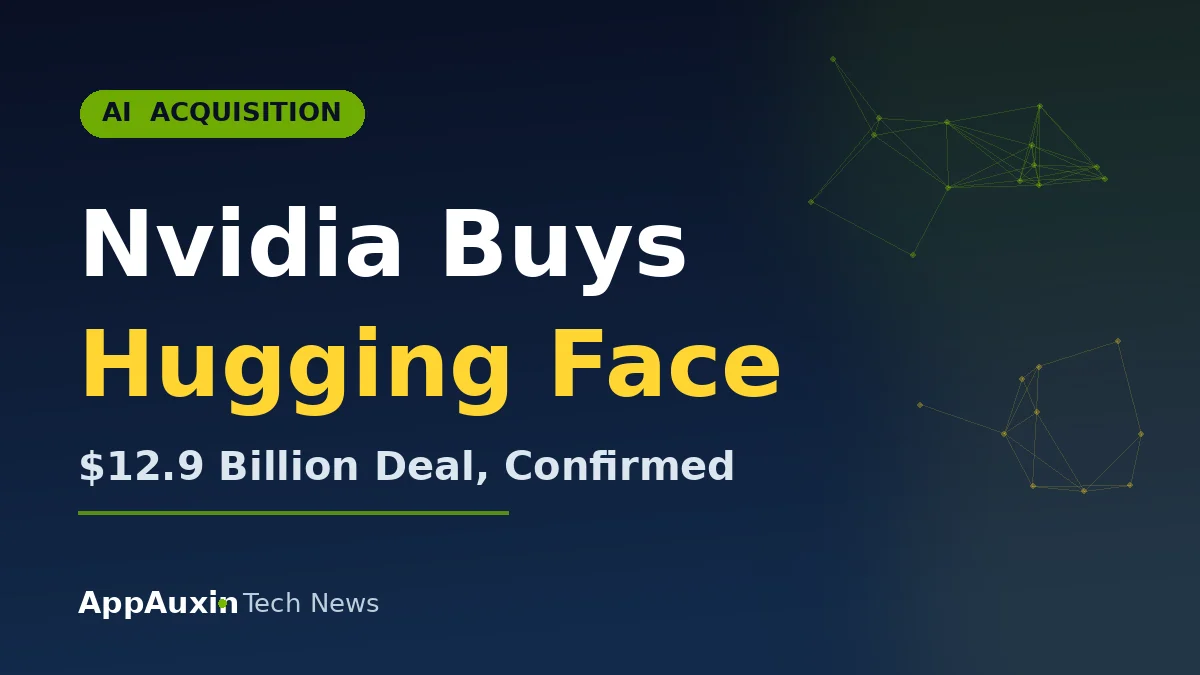
The Nvidia Hugging Face acquisition just became official. On September 3, 2026, Nvidia confirmed it’s paying $12.9 billion for the open-source hub that quietly powers a huge chunk of the AI tools you already use. If you’ve touched a chatbot, an image generator, or a coding assistant this year, there’s a good chance a model hosted on Hugging Face was doing some of the work.
- Price: Nvidia is paying $12.93 billion for Hugging Face, confirmed on September 3, 2026
- Who’s affected: more than 18 million developers who rely on Hugging Face’s models, datasets, and hosting tools
- What stays the same: founders Clem Delangue, Julien Chaumond, and Thomas Wolf keep running the platform, and the brand isn’t disappearing
- The big promise: Nvidia says its own chips won’t be required to build or deploy anything on Hugging Face
- What’s still unknown: no official closing date for the deal has been announced yet
How We Got Here: From Rumor to a $12.9 Billion Deal
This didn’t come out of nowhere. TechCrunch first reported Nvidia was closing in on a deal in late August, and both companies confirmed it a week later. Hugging Face had reportedly turned down a smaller $500 million investment offer late last year that would have valued it at $7 billion.
Instead, the company held out, and the price roughly doubled. That’s a striking jump for a startup whose annual revenue is estimated at around $150 million. It shows how much strategic value Nvidia places on owning the layer where developers actually work, not just the chips underneath it.
Nvidia already sells hardware built for exactly this kind of workload, like the RTX Spark AI PC. But this deal isn’t about silicon. It’s about owning the software front door that millions of developers walk through every day.
Why Nvidia Wants to Own an Open-Source AI Hub
Hugging Face isn’t a household name the way ChatGPT or Gemini is, but among people who actually build AI software, it’s closer to essential infrastructure. It hosts more than 3 million machine learning models, over 1 million apps, and roughly 500,000 datasets.
Nvidia’s core business is selling the chips that train and run those models. Owning the platform where developers discover, share, and deploy them gives Nvidia visibility into exactly what the industry is building next — and a direct relationship with the people building it.
CEO Jensen Huang has framed it as expanding access rather than locking anyone in. Hugging Face founder Clem Delangue put it plainly: the platform “needs more compute, more support, more collaboration, and more visibility” than it could get on its own.
The Nvidia Hugging Face Acquisition Raises a Neutrality Problem
Here’s the tension. Hugging Face built its reputation as a neutral ground — a place where AI teams at AMD, Intel, Google, and Amazon could all publish and share models without playing favorites. Nvidia now owns that ground.
Roughly 41% of the models hosted on Hugging Face reportedly come from Chinese AI labs. That adds a layer of cross-border regulatory complexity most acquisitions never have to deal with. Some in the open-source community have reportedly floated forking the platform entirely rather than depend on a rival’s owner for their tooling, according to PCMag’s analysis of the deal.
Nvidia’s written commitment is specific: its own compute “will not be required to build on or deploy through Hugging Face.” That’s a meaningful line to put in writing. But it doesn’t erase the incentive problem — a chipmaker now controls the shop window for its rivals’ software.
Before and After: What Actually Changes
It helps to see the shift side by side. The day-to-day experience for developers isn’t changing yet, even though the ownership structure fundamentally has.
| Attribute | Before the Deal | After the Deal |
|---|---|---|
| Ownership | Independent startup | Wholly owned by Nvidia |
| Leadership | Delangue, Chaumond, Wolf | Same team stays on |
| Hardware requirement | None — multi-vendor by design | Nvidia pledges none, in writing |
| Funding pressure | Relied on outside investment rounds | Backed by Nvidia’s balance sheet |
| Regulatory status | Not applicable | Facing antitrust scrutiny |
What This Means for the AI Tools You Actually Use
If you’re not a developer, the honest answer is: probably not much, at least not immediately. The apps and models you already rely on should keep working exactly as they do now.
If you build with AI — fine-tuning open models, running local inference, or shipping a product on top of Hugging Face’s libraries — the practical advice right now is to watch, not panic. Nothing about your workflow needs to change today.
The bigger question is a few years out. Does an Nvidia-owned Hugging Face keep treating every chipmaker equally, or does support for non-Nvidia hardware quietly get slower and less polished? Frontier releases like GPT-6 Astra show how fast AI development already moves, and owning the distribution layer only compounds Nvidia’s advantage in that race.
The Antitrust Minefield Ahead
Nvidia has been here before, and it didn’t go well. Its attempted $40 billion acquisition of chip designer Arm collapsed in 2022 after regulators in multiple countries pushed back hard.
Nvidia is already framing this deal differently, arguing it’s a “deconcentration” move — spreading access to AI infrastructure rather than tightening control over it. Whether antitrust regulators in the US, EU, and elsewhere see it the same way is a genuinely open question.
Given how central Hugging Face has become to the broader AI ecosystem, expect this deal to draw real regulatory attention before it fully closes.
Frequently Asked Questions
What exactly did Nvidia buy when it acquired Hugging Face?
Nvidia bought the entire Hugging Face platform — its model repository, hosting infrastructure, datasets, and the company itself — for $12.93 billion, confirmed on September 3, 2026.
How much did Nvidia pay for Hugging Face?
The confirmed price is $12.93 billion, roughly double the $7 billion valuation Hugging Face turned down in a smaller funding offer late last year.
Will Hugging Face still work with AMD and other non-Nvidia chips?
Nvidia has publicly committed that its hardware won’t be required to build on or deploy through Hugging Face, meaning the platform should stay usable with AMD, Intel, and other accelerators for now.
Is this deal final, or does it still need regulatory approval?
The deal has been confirmed by both companies, but no official closing date has been announced. It’s likely to face antitrust review given Nvidia’s dominant position in AI chips.
What happens to my existing Hugging Face account or models?
Nothing changes for existing accounts, uploaded models, or datasets right now. The founding team is staying on to run day-to-day operations, and the brand isn’t being folded into Nvidia’s.
My take: this is a smart, defensible move for Nvidia on paper, and an uncomfortable one for everyone who depends on Hugging Face staying neutral. Written promises about hardware independence are worth something, but they’re not the same as structural independence. How Nvidia actually runs the platform over the next few years will matter far more than this week’s press release.
Leave a Reply