
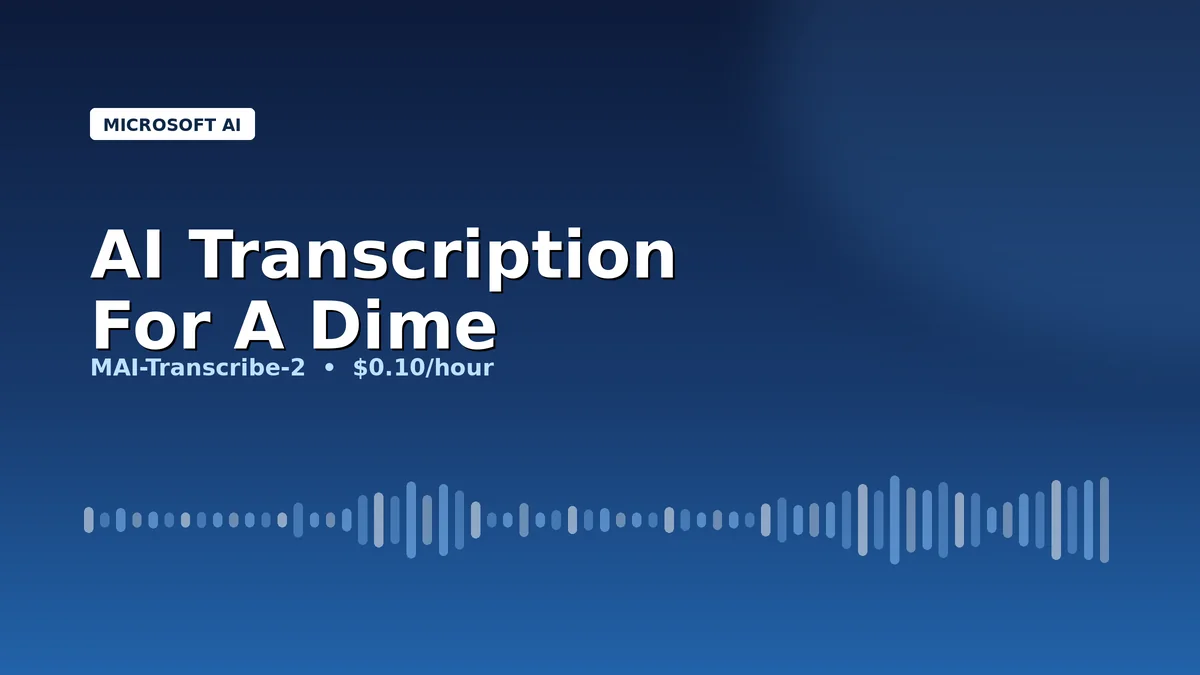
Microsoft just made every other speech-to-text tool look expensive. Its new MAI-Transcribe-2 model turns an hour of audio into text for a dime. Microsoft says it beats OpenAI, Google, and ElevenLabs on speed and accuracy at once, so if you use dictation apps, YouTube captions, or meeting-note tools, this price cut will likely show up in your software within months.
- Release date: September 3, 2026
- Price: $0.10 per hour of audio, a 72% cut from the original model’s $0.36/hour rate
- Speed: Up to 10x faster than OpenAI’s GPT-Transcribe, per Microsoft’s own benchmarks
- Language coverage: 60 languages, up from 25 at launch back in April 2026
- Built by: A 10-person team inside Microsoft AI, led by Mustafa Suleyman
What MAI-Transcribe-2 Actually Does Differently
Most speech-to-text tools force a trade-off: fast and cheap, or accurate and slow. MAI-Transcribe-2 is Microsoft’s attempt to break that trade-off, and the early numbers back it up. The model tops the FLEURS multilingual benchmark across 60 languages with a 5.2% average word-error rate. It also lands near the top of the independent Artificial Analysis accuracy leaderboard.
It’s built for the unglamorous jobs that make transcription genuinely useful day to day. Speaker diarization tells voices apart in a group meeting, and word-level timestamps let you scrub straight to a specific line in a recording. Keyword biasing stops it from mangling a company’s product names or a doctor’s clinical shorthand, and code-switching means it won’t stumble when a conversation drifts between English and Spanish or Hindi mid-sentence.
None of this is flashy the way a chatbot demo is. But if you’ve ever waited ten minutes for a 40-minute podcast to transcribe, or watched auto-captions butcher a technical term, you already know why this kind of unglamorous progress matters.
MAI-Transcribe-2 Price and Speed vs. the Competition
In Microsoft’s own benchmark tests, MAI-Transcribe-2 is measured directly against tools you’ve probably used already: OpenAI’s GPT-Transcribe, ElevenLabs’ Scribe v2, and Google’s Gemini 3.5 Transcribe. The gap in reported speed is large enough to notice in everyday use, not just on a spec sheet.
| Model | Speed vs. MAI-Transcribe-2 |
|---|---|
| MAI-Transcribe-2 | Baseline — fastest of the four tested |
| OpenAI GPT-Transcribe | 10x slower |
| ElevenLabs Scribe v2 | 7x slower |
| Google Gemini 3.5 Transcribe | 5x slower |
For anyone paying per-minute transcription fees inside a podcast editor or call-recording app, that speed gap plus the lower AI transcription price can be the difference between a report that’s ready in minutes and one you’re waiting on overnight.
The Ten-Person Team Behind a Frontier AI Model
Big AI launches usually come wrapped in vague talk of thousands of engineers and oceans of compute. MAI-Transcribe-2 didn’t. Microsoft AI CEO Mustafa Suleyman told The Verge it came out of a small, focused ten-person team. He said an earlier version of the model already ran at half the GPU cost of comparable state-of-the-art systems.
Suleyman joined Microsoft in 2024 after the company’s unusual talent deal with Inflection AI. Since then, he’s pushed Microsoft’s AI division toward narrower, cheaper, purpose-built models instead of one giant do-everything system. MAI-Transcribe-2 is that philosophy made concrete: pick a single job, then do it better and cheaper than anyone else. This is already the third version released since April 2026.
OpenAI took a different route the same week, answering with GPT-6 Astra, a broad reasoning model rather than a narrow, cheap transcription tool. The contrast is a useful snapshot of where the two companies are placing their bets right now.
Where You Can Use MAI-Transcribe-2 Right Now
MAI-Transcribe-2 isn’t a standalone app you download today — you’ll meet it indirectly, through tools built on top of it. Right now it’s reachable through the Microsoft Foundry and MAI Playground speech-to-text API. Third-party routing services like Open Router also carry it, which is how developers plug it into their own products.
The $0.10-per-hour rate is a limited-time offer running through the end of 2026. Microsoft is clearly betting that undercutting rivals now builds habit and market share before prices normalize. Practical uses already being floated include clinical note-taking, legal documentation, live closed captioning, and accessibility tools for people who are deaf or hard of hearing.
Google has been chasing similar ground from a different angle. Its Gemini Auto Browse rollout on Android shows the same instinct to make AI features faster and more embedded in everyday tools, just aimed at browsing the web instead of transcribing audio.
Frequently Asked Questions
What is MAI-Transcribe-2?
It’s a speech-to-text AI model Microsoft released on September 3, 2026, built for tasks like meeting notes, captions, and clinical or legal transcription. Microsoft says it’s faster and more accurate than comparable models from OpenAI, Google, and ElevenLabs.
How much does MAI-Transcribe-2 cost?
It’s priced at $0.10 per hour of audio through the end of 2026, down 72% from the $0.36-per-hour rate of the original MAI-Transcribe model launched in April 2026.
Can regular people use MAI-Transcribe-2, or is it just for developers?
Right now it’s accessed through developer-facing platforms like Microsoft Foundry, the MAI Playground, and Open Router. Most people will encounter it indirectly, once other apps and services integrate the model behind the scenes.
How does MAI-Transcribe-2 compare to OpenAI’s Whisper?
Microsoft benchmarks it against OpenAI’s newer GPT-Transcribe rather than the older Whisper model directly. It reports MAI-Transcribe-2 runs up to 10 times faster while ranking higher on multilingual accuracy tests.
Will the $0.10-per-hour price stick around?
Microsoft has only committed to that rate through the end of 2026. Given that the previous version’s price dropped 72% in under six months, further changes in either direction wouldn’t be surprising.
Price wars in AI usually happen in flashy categories like chatbots and image generators. It’s a little refreshing to see one break out over something as unglamorous as transcription instead. The real winners here aren’t developers comparing benchmark charts — they’re the students, podcasters, and clinicians who’ll quietly get cheaper, faster tools without ever learning the model’s name. That’s a better outcome than another headline-grabbing chatbot, and it’s worth watching whether OpenAI and Google answer with cuts of their own.
Leave a Reply