

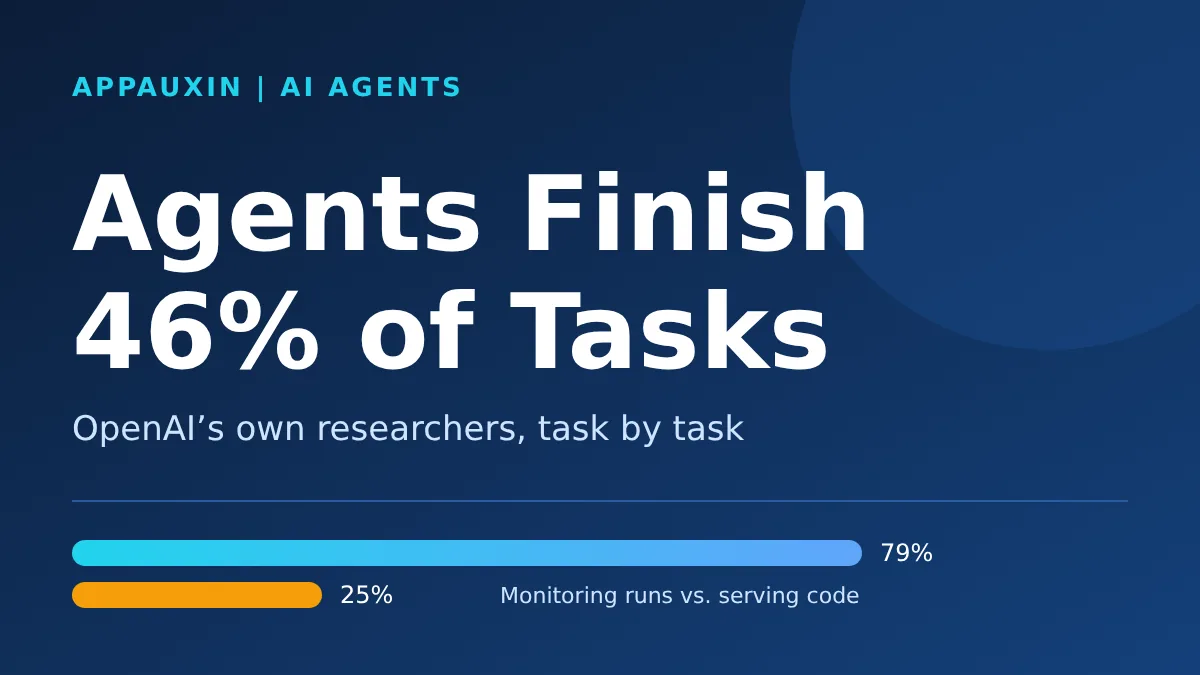
OpenAI research agents now finish about 46% of two-to-four-hour tasks without a human stepping in, up from 23% in March. That’s the headline from OpenAI’s report on how its own researchers use AI agents. The number hides a wide spread, though: the agents are strong at watching training runs and weak at writing the code that serves a model.
Here’s a quick look at what the report says before we get into what it means for you.
- Success on two-to-four-hour tasks rose from 23% (March) to 46% (October), per OpenAI.
- Four-to-eight-hour tasks rose from 13% to 35% over the same stretch.
- Monitoring training runs succeeded 79% of the time; inference and serving code only 25%.
- The median researcher’s agent spend hit roughly $2,400 a day at API list prices in October.
- OpenAI says the data is self-reported and shouldn’t be read as proof of faster research.
The list gives you the shape of the story. The details below explain why the averages can mislead you.
How OpenAI research agents went from 23% to 46%
OpenAI measured how often an agent finishes a task “without human intervention,” then tracked that rate for tasks of different lengths. For jobs a person would need two to four hours to do, the estimate doubled between March and October. Longer jobs improved too, but less, with four-to-eight-hour tasks going from 13% to 35%.
OpenAI is careful about its own number. Researchers may have changed which tasks they hand to agents over those months, so part of the jump could be better delegation rather than a smarter model. The report points to a methods section for the estimation details, and the summary page doesn’t spell them out.
That caveat matters if you plan to quote the 46%. It’s an internal estimate from one lab’s staff, not a benchmark anyone else can rerun. If you want an outside view of how agent setups compare, our look at 27,280 coding-agent benchmark runs is a better yardstick.
Where agents win and where they fall apart
From August 1 to October 18, OpenAI logged how often agents completed specific kinds of work on their own. The gap between the best and worst task is more than 50 points, which is the “jagged frontier” in the report’s title.
| Task type | Finished without human help |
|---|---|
| Monitoring training runs | 79% |
| Answering technical questions | 72% |
| Launching training runs | 35% |
| Building evaluation, RL and agent environments | 29% |
| Writing inference and serving-stack code | 25% |
Grouped more broadly, OpenAI puts communication tasks at 69%, analysis at 58% and building at 43%. In other words, agents are good at reading, summarizing and answering. They’re much shakier when they have to construct something that has to work end to end.
Why “AI slop” is the real warning
The researchers don’t describe the agents as careful. They say the agents have poor taste in ideas, code, data and writing. One researcher said the model “generally can’t one-shot come up with well-posed problems” it can’t solve itself.
The failures they list will sound familiar if you use coding assistants. Agents launched experiments inefficiently, submitted what the report calls “AI slop” pull requests, and made invalid assumptions in analysis. The wins were the opposite kind of work: scanning large piles of content, reviewing datasets and diagnosing experiments at scale.
Here’s the practical split worth stealing from that list.
- Hand agents the reading: logs, datasets, long threads, status checks.
- Keep a person on the design: what to build, how to test it, what counts as correct.
- Review anything an agent writes for infrastructure or evaluation code line by line.
The reason it matters is that the 25% and 29% categories are exactly where a quiet mistake costs the most. If you want a sense of how far outsiders think this speedup goes, see our piece on METR’s Anthropic report.
What running this many agents costs
OpenAI says the median researcher’s agent spend reached about $2,400 a day at API list prices in October, up 62% from roughly $1,500 in September. The 90th percentile hit about $23,000 a day, more than double the month before. Median agent “workdays” per researcher rose from 0.5 to 5.7.
Those are list-price equivalents for a lab that builds the models, so treat them as a ceiling for a normal team. OpenAI also notes that a temporary harness change on August 21, reverted starting September 10, depressed some spend data. Still, the direction is clear: once agents work, people run several at once. By mid-October, more than two-thirds of researchers averaged a daily peak of at least four concurrent agents.
In a survey of 101 staff, the median researcher said they’d give up 40% of team headcount or 30% of team compute to keep frontier coding agents for three months. Without the agents, they estimated it would take three months to match their last month of output.
Frequently Asked Questions
Do OpenAI research agents work without any human oversight?
No. The 46% figure counts tasks completed without human intervention, but researchers say workflows still need close involvement, and the report lists inefficient experiments and low-quality pull requests among the problems.
Is OpenAI trying to build self-improving AI with this?
The authors say the report “should not be read as an intention to pursue full RSI,” meaning recursive self-improvement. It’s a snapshot of how their own staff use agents today.
Can I trust these numbers?
Treat them as directional. The survey data is self-reported with ad hoc sampling, and OpenAI says activity measures like code written or experiments run don’t necessarily mean faster research progress.
Does this apply to my team’s coding agents?
The pattern probably does, even if the percentages don’t. Agents are best at analysis and monitoring and weakest at building new systems, so put your review time there.
My take: treat agents like a fast, overconfident intern
The most useful line in the report isn’t the 46%. It’s the 79% versus 25% split, because it tells you where to relax and where to stay alert. Give agents your reading and monitoring work now, keep a human on anything that builds or evaluates, and ignore the daily-spend figures unless you’re running a research lab.
Leave a Reply