

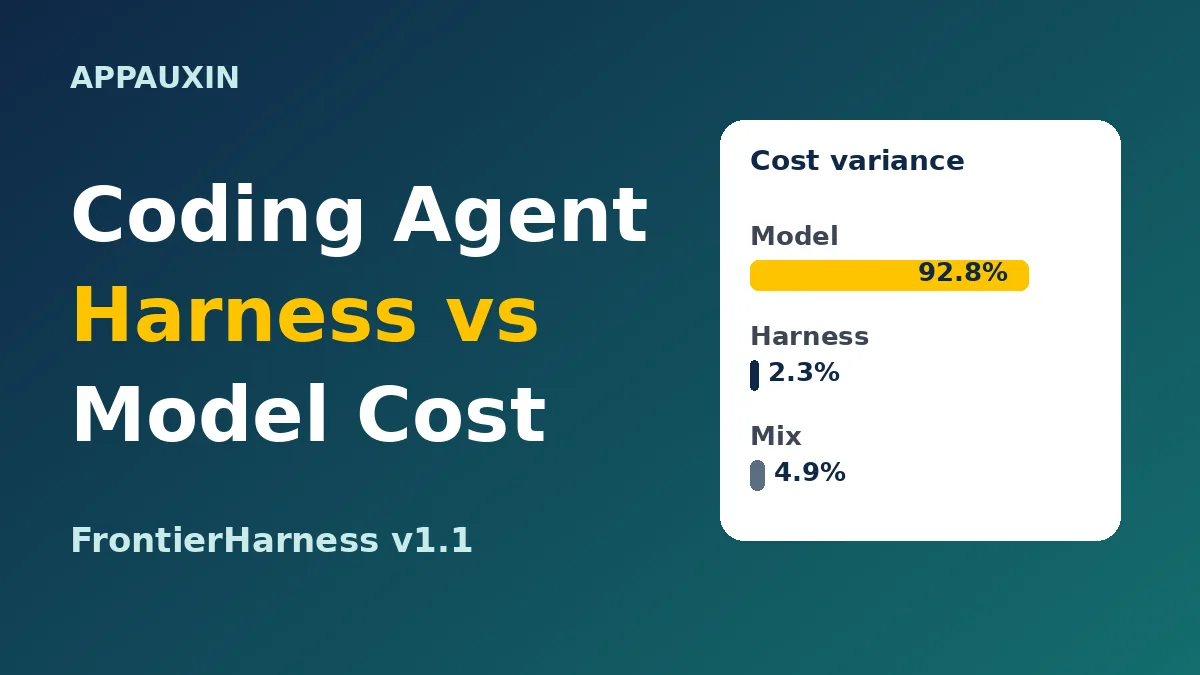
Your coding agent harness matters far less than the model running inside it, at least when it comes to cost. In its FrontierHarness Eval v1.1, published November 17, 2026, Runta found the model explains 92.8% of the cost differences across 27,280 agent runs. The harness still matters in one way: the wrong pick can cost you up to five times as much per task.
Here are the quick facts:
- Who ran it: Runta, in a post by Shilin Zhu dated November 17, 2026
- Scale: 27,280 runs across 22 harness configurations, 5 open models and 62 terminal tasks
- Top pass rate: Pi, Codex CLI and ZCode tied at 61.9%
- Catch: Only open models were tested, all served through one provider, Baseten
That last point limits how far you should stretch the results, and I’ll come back to it.
Why the model sets most of your coding agent harness bill
Runta ran a two-way ANOVA on log cost per task to split the variance by cause. In plain terms, it asked how much of the cost spread comes from the model, how much from the harness, and how much from the mix of the two.
| Source of cost variance | Share |
|---|---|
| Model | 92.8% |
| Harness | 2.3% |
| Model and harness pair, including noise | 4.9% |
If you’re shopping for savings, that table says to start with the model. Swapping harnesses on a fixed model moves the bill far less than swapping models does.
Where the harness still costs you: up to 5x per task
A small share of the variance can still be a big number in dollars. With the model held fixed, the most expensive harness cost 1.8 to 5.0 times as much per task as the cheapest, according to Runta.
The widest gap showed up with DeepSeek. Cline CLI cost 5.0 times as much as OpenCode v1 while adding only 2.0 points of pass rate. With the other four models, the cheapest and priciest harnesses differed by at most 0.4 points.
Paying more didn’t buy better results. Within each model, the rank correlation between cost per task and pass rate ran from -0.39 to +0.22, and the highest-scoring harness ranked anywhere from 5th to 20th of 22 on cost.
The best coding agent harness changes with the model
There’s no single winner. Runta named a best-value harness for each model, and the five picks are all different.
| Model | Best-value harness |
|---|---|
| GLM-5.3 | Codex CLI |
| GLM Flash | Pi |
| DeepSeek V4.1 Flash | ZCode |
| Muse | Oh My Pi |
| Kimi-K3 | Alma |
Codex CLI is the cautionary tale. It ranked first on cost with GLM-5.3 but 16th with Kimi-K3, and the median harness moved 11 of 22 places when the model changed.
Not every winner is equally solid. In Runta’s bootstrap test, Codex CLI stayed first with GLM-5.3 in 99.6% of draws, while the other four winners held the top spot only 25% to 53% of the time.
Where the money goes: runs that never pass
The most useful number in the post is about waste. On scored runs, 64.5% of list-price cost went to trials that didn’t pass: 52.7% to outright failures and 11.8% to timeouts.
So what drives cost? Steps per pass correlated with cost per pass at +0.51. Prompt size, tool count and cache hit rate didn’t correlate with it at all, per Runta.
Runta also noted what the best-value harnesses had in common, and it flags this as observation, not a tested cause. They leaned on one shell tool for 61% to 93% of calls, kept context growing so caching worked, and rarely used subagents or summarization.
If you build agents, the lesson is to cut steps before you trim prompts. If you use them, it’s a reason to watch for runs that spin without progress. Our look at Kiro Bots and their credit bill shows how fast that kind of spend adds up.
How far to trust these results
Treat this as a strong signal, not a verdict. Runta lists several limits, and the FrontierHarness site names Runta, Baseten and Z.ai as sponsors.
- Only open models were tested, all through one provider, so closed models could rank harnesses differently.
- Pass rates carry roughly 10-point 95% intervals, so small gaps are effectively ties.
- 216 trials were flagged for reward hacking, 163 of them for online lookups, and scored zero.
Runta says closed models such as Claude Opus 5.5, GPT-6 Astra and Gemini 4 Carbon are planned for later rounds. Until then, a result for one model shouldn’t be assumed to hold for another.
Should you switch harnesses?
Probably not on the strength of a leaderboard. Pick your model first, then run 20 or so of your own real tasks through two or three harnesses and compare cost per passing task. If you’re already weighing a different tool, our piece on Android Studio Rabbit 2 and bring-your-own-agent is a good example of why that flexibility is worth testing.
Frequently Asked Questions
What is a coding agent harness?
It’s the software wrapper around the model, such as Codex CLI or OpenCode. It handles the tools, context and loop that let the model read files, run commands and edit code.
What is FrontierHarness Eval?
It’s Runta’s benchmark that compares coding agent harnesses on the same terminal tasks. Version 1.1 is 76 times larger than v1.0, which ranked nine harnesses on a single model.
Did FrontierHarness test Claude or GPT models?
Not yet. Version 1.1 used GLM-5.3, GLM Flash, DeepSeek V4.1 Flash, Muse and Kimi-K3. Closed models are planned for a later round.
Does a more expensive harness pass more tasks?
No. Runta found no reliable link between cost and pass rate within any model it tested.
Leave a Reply