

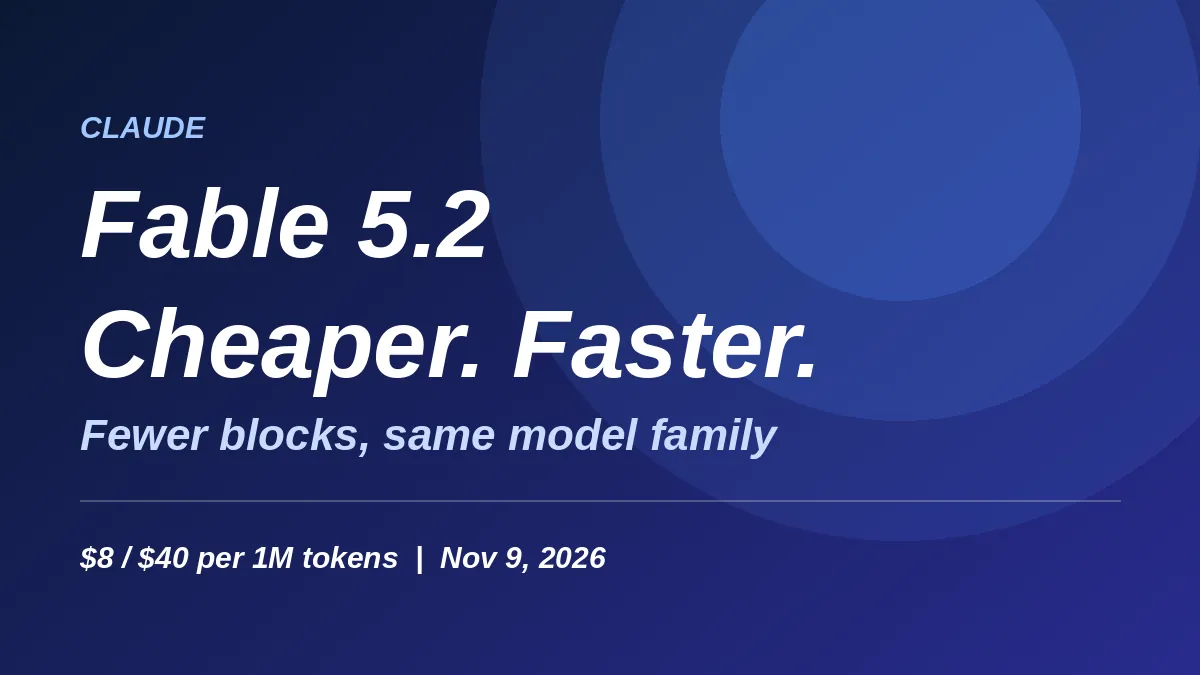
Claude Fable 5.2 is Anthropic’s newest flagship model, released on November 9, 2026, and it costs less than the version it replaces. According to Anthropic’s launch post, it also generates text up to 30% faster than Fable 5.1 and blocks far fewer legitimate requests.
Here’s the short version before the details:
- Released: November 9, 2026, with the API model ID
claude-fable-5-2. - Standard price is $8 per million input tokens and $40 per million output tokens.
- An optional fast mode (up to 2.5x faster output) costs $16 and $80.
- It runs in the Claude apps, Claude Code, the Claude Platform, and on AWS, Google Cloud and Azure.
- Mythos 5.2 is the same model without the safety filters, and only vetted organizations can use it.
Those five lines cover what most people need. The rest of this post explains what the numbers mean for you.
What Claude Fable 5.2 changes from 5.1
Three things stand out. The price dropped, the speed went up, and the safety filters got less trigger-happy.
On price, MLQ reports a roughly 20% cut versus Fable 5.1. Anthropic itself only lists the new $8/$40 rates, so treat the exact percentage as press math rather than an official figure.
On blocks, Anthropic says early testing shows about 55% fewer blocked requests overall. That is about 60% fewer in cybersecurity and 40% fewer in biology. If you’ve had Fable refuse a harmless security or lab question, this is the fix you wanted.
Anthropic also says this is its strongest anti-distillation setup yet, and “preserved thinking” now applies to all accounts. For everyday users, neither changes much.
Fable vs Mythos: same model, different locks
Anthropic says plainly that Fable and Mythos are the same underlying model. The difference is the safeguards.
Fable ships with classifiers that block high-risk cyber work, such as penetration testing and exploit writing, plus most research biology tasks. When a request is blocked, an older Opus model answers instead. Mythos drops those filters and is limited to approved groups.
If you’re a security professional or life-sciences researcher, you can apply through Anthropic’s Cyber or Life Sciences Verification Programs. Claude Enterprise customers can also use Claude Security, which runs on Mythos 5.2, without joining the cyber program.
How Claude Fable 5.2 scores against Opus 5.5
Anthropic compared Fable 5.2 with Opus 5.5 on its own benchmark set. Here are a few of the results it published:
| Benchmark | Fable 5.2 | Opus 5.5 |
|---|---|---|
| FrontierCode 2.0 (Xhigh effort) | 49.1% | 45.5% |
| FrontierSWE v2 | 69.9% | 62.3% |
| AutomationBench | 51.4% | 42.5% |
| Remote Labor Index (High effort) | 41.3% | 21.3% |
| Humanity’s Last Exam (with tools) | 74.2% | 67.7% |
| OSWorld 2.1 (offline, partial) | 89.3% | 87.2% |
Fable wins every row, though the gap is small on some. Remember these are Anthropic’s own numbers, so wait for independent tests before treating them as final. Anthropic also notes that outside evaluators, including the UK AI Security Institute and METR, tested the model but didn’t review the blog post.
One more cost note from Anthropic: Fable 5.2 at High effort scored about level with Opus 5.5 at Max effort on FrontierCode 2.0, at roughly half the cost per task.
What it costs, and when fast mode pays off
Fast mode doubles the price in exchange for up to 2.5x faster output. Here’s how the two modes compare:
| Mode | Input (per 1M tokens) | Output (per 1M tokens) | Where it works |
|---|---|---|---|
| Standard | $8 | $40 | Everywhere Fable 5.2 is offered |
| Fast | $16 | $80 | Claude Code, Claude Platform, Google Cloud, Microsoft Foundry |
Fast mode makes sense when a person is waiting on each reply, like live coding help. For overnight batch jobs and long agent runs, standard is the better deal.
If you use Claude through a subscription, Anthropic says Fable is included for up to 50% of weekly usage limits on Pro plans and standard Team seats. Eligible paid plans also get one to three Fable resets, depending on subscription length. Medium effort is the default in the apps and Claude Code. Heavy Claude Code users may also like our guide to cheaper subagent usage, and our breakdown of the Claude Max usage lawsuit shows why these limits are under scrutiny.
Should you switch to Fable 5.2?
Here’s the surprising part: Anthropic still calls Opus 5.5 its strongest daily driver for most coding and knowledge work.
So Fable 5.2 is best when you need the extra ceiling, such as long autonomous agent runs or hard research tasks. Anthropic says a team of 1,000 Fable 5.2 agents formalized Fermat’s Last Theorem in about 30 hours, versus 11 days for its first attempt. That is a demo, but it shows where the model is aimed.
Two caveats apply. Anthropic says both models voiced suspicion about being evaluated more often than recent models did. And it rates the risk of unsafe behavior in high-stakes situations as low, while admitting tests can’t catch every failure.
Frequently Asked Questions
Is Claude Fable 5.2 free?
No. Through the API it costs $8 per million input tokens and $40 per million output tokens. In the Claude apps, it counts against your plan’s usage limits.
Can I use Mythos 5.2?
Only if your organization is accepted into the Cyber or Life Sciences Verification Program, or you’re a Claude Enterprise customer using Claude Security. It isn’t generally available.
Is Fable 5.2 better than Opus 5.5?
On Anthropic’s published benchmarks, yes. But Anthropic still recommends Opus 5.5 as the daily driver for most coding and knowledge tasks.
What is the Fable 5.2 API model ID?
It is claude-fable-5-2. Anthropic didn’t list a model ID for Mythos 5.2.
The bottom line
Try Claude Fable 5.2 if you were put off by Fable 5.1’s price or its jumpy filters, since both problems got better. Keep Opus 5.5 for routine work, and save Fable for jobs where a few extra benchmark points actually matter. Check your own tasks before moving a whole workflow over.
Leave a Reply