

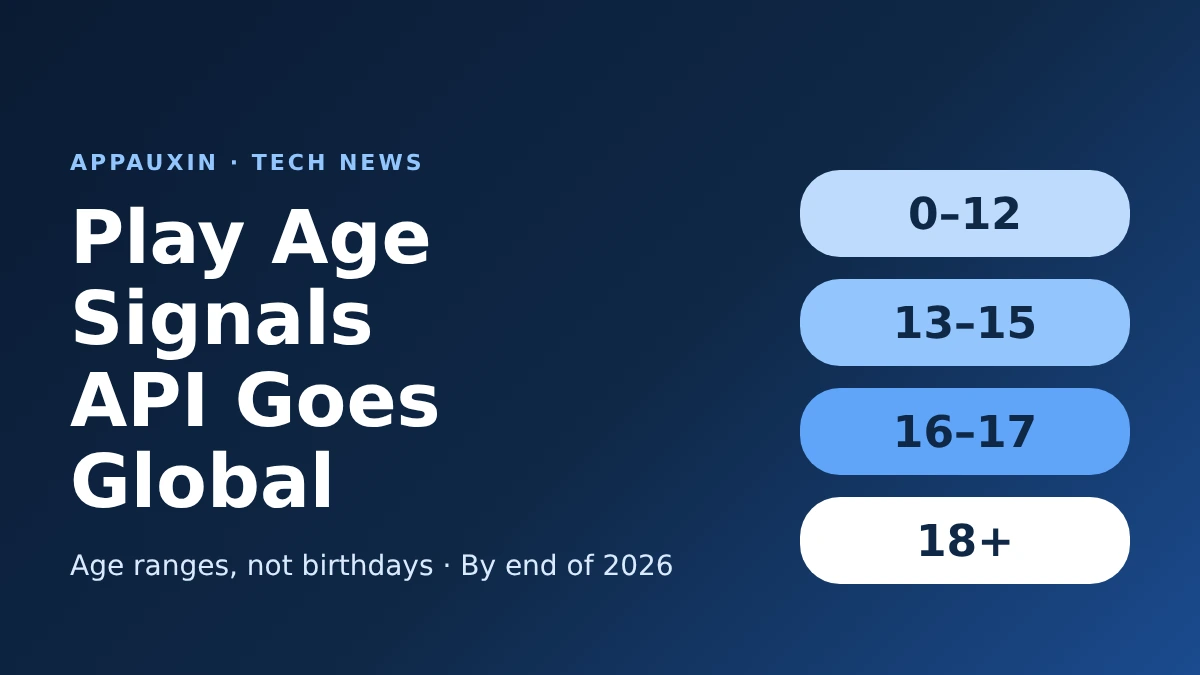
The Play Age Signals API is Google’s way of telling Android apps roughly how old their users are, and Google says it will reach every market by the end of 2026. Apps receive an age range, such as 16-17, and never a birthday. Parents choose whether to share it, so nothing is passed along by default.
Here’s the short version for skimmers:
- What apps get: an age range, not a date of birth
- Default ranges: 0-12, 13-15, 16-17 and 18+
- Who decides: parents, through the Family Link app
- Already live: Brazil, plus eligible new accounts in Texas
- Global rollout: all remaining markets by the end of 2026, per Google
Why now? Lawmakers keep pushing app stores to protect minors, and TechCrunch notes that Apple already launched its own age-verification tools worldwide in February 2026.
What the Play Age Signals API actually tells an app
The API answers one narrow question: which age bucket does this user fall into? According to the Android developer documentation, the default buckets are 0-12, 13-15, 16-17 and 18+, and developers can also define custom ranges. It runs on Android 6.0 (API level 23) or higher, on phones, foldables and tablets.
Google calls it privacy-preserving because the app never sees a birth date or other personal details. An app can use the range to tune content, features or settings for a younger audience instead of applying one rule to everyone.
The API doesn’t enforce anything by itself. An app decides what to do with the range, so a kids’ game might hide chat for users under 16 while a news app does nothing at all.
Adults are part of this too. Google says adults can share their own age when a developer prompts them.
Where the Play Age Signals API is live and what comes next
The rollout is staggered, and it’s driven partly by local law. This table pulls together what Google and its release notes say so far:
| Region | Status | Why |
|---|---|---|
| Brazil | Live since March 17, 2026 | Requirements under Digital ECA |
| Texas, US | Live for eligible users whose accounts were created after May 28, 2026 | Texas SB2420 |
| Australia and Canada | Planned for mid-August 2026, per Google | Part of the global expansion |
| Everywhere else | Planned by the end of 2026 | Global rollout |
| Other US states | No dates given | Google says it will post updates before new age-verification laws take effect |
Texas shows how law is shaping the design. Signals only flow for eligible accounts created after May 28, 2026, so the same app can see an age range for one Texas user and nothing for another.
Google hasn’t said exactly when your country is next. If you’re outside the first markets, expect the feature to arrive quietly in a Play update rather than with an announcement.
How parents control what gets shared
Parents manage this in one place, the Family Link app, instead of app by app. Google’s launch post says age ranges are “never shared by default,” and that parents can change or turn off sharing at any time.
Once a parent opts in, any Play app that uses the API can receive the range. That’s convenient, but it also means one switch covers many apps, so it’s worth knowing the setting exists.
Google is also building out family tools elsewhere in Android. Our look at the Android Family Hub in Settings covers the parent-facing side of that work.
One more clue: Google’s own changelog for Play services 26.44, covered by 9to5Google, lists a new API that lets apps query a device user’s age range. The changelog doesn’t say whether that’s the same system, so treat the connection as likely, not confirmed.
What app developers need to change in version 0.0.4
If you build apps, the July 2026 library release matters. The release notes list four changes you have to handle:
- Call the new
requestAgeSignalsAccess(), which shows the Play prompt for age-range sharing - Still call
checkAgeSignals()to read the result; you need both - Stop using
userStatus, which is deprecated; useageRangeSourceandsignificantChangeStatusinstead - Rename
mostRecentApprovalDatetosignificantChangeApprovalDate
The dependency line is com.google.android.play:age-signals:0.0.4. The docs also offer a FakeAgeSignalsManager for unit tests, so you can try the flow without real users. The API is still labeled beta in Google’s terms, so expect more changes.
Not every detail is on the pages we checked. Null handling and privacy limits sit on linked documentation pages, so read those before shipping.
Frequently Asked Questions
Does the Play Age Signals API share my birthday?
No. Apps get an age range such as 13-15 or 18+, not a date of birth or other personal information, according to Google.
Is age sharing turned on automatically?
No. Google says ranges are never shared by default. Parents opt in through Family Link and can turn it off later.
When does the Play Age Signals API reach my country?
Google says all remaining markets get it by the end of 2026, but it hasn’t published a country-by-country schedule. Brazil, Texas, Australia and Canada come first.
Do all apps have to use it?
Google’s announcement presents it as a choice for developers who want to tailor an app to their audience. Laws like Texas SB2420 and Brazil’s Digital ECA may still push some apps to use it.
Should you care about the Play Age Signals API?
If you’re a parent, yes: open Family Link this month and decide whether you want age ranges shared at all, because the default is off. If you’re a developer, update to 0.0.4 now and test with the fake manager, since the two-call flow breaks old code. Everyone else can ignore it for the moment, but expect more apps to ask your age as the global rollout lands.
Leave a Reply