

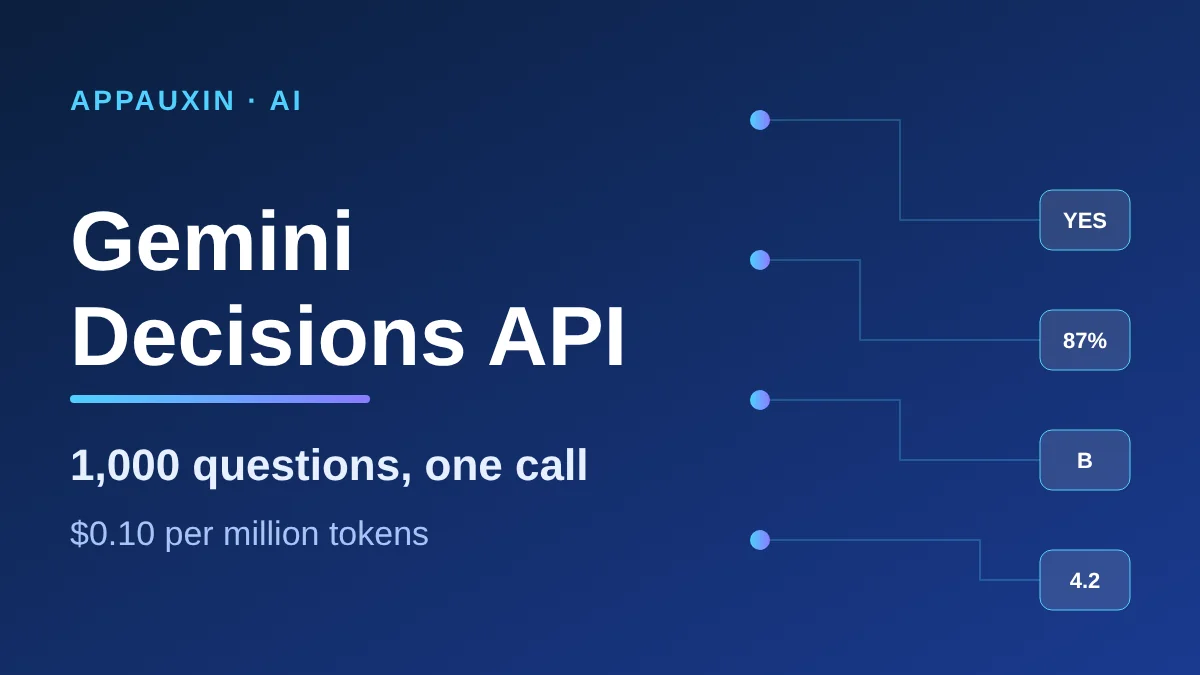
The Gemini Decisions API lets you send one pile of evidence and up to 1,000 questions, then get back probabilities instead of paragraphs. Google DeepMind released it on November 11, and it costs $0.10 per million input tokens with free output, according to VentureBeat. If you build anything that sorts, checks or routes documents, this is worth ten minutes of your time.
Here are the facts that matter most before we get into the details.
- Released November 11, 2026 as part of the Gemini Developer API (
v1betaendpoint) and Google AI Studio. - Price: $0.10 per million input tokens, with no charge for output.
- Up to 1,000 questions per request, with a 262,144-token limit for the shared evidence, instructions and choices.
- Inputs can be text, images, audio, video or PDFs.
- Google reports 150-250 ms end-to-end for inputs up to 16K tokens.
That latency is the quiet headline. A full set of decisions can come back faster than most chatbots finish their first word.
How the Gemini Decisions API works: scores instead of sentences
Normal language models write an answer. This one never writes anything. You give it shared evidence, such as a scanned claim form, a few photos and call notes, plus a list of questions, and it returns a probability and a confidence score for each.
Each question is scored on its own, so your code decides what to do with the numbers. The question types are simple.
| Question type | What you get back | Limit |
|---|---|---|
| Yes/no check | A probability that the answer is yes | Counts toward 1,000 per request |
| Multiple choice | A probability for each option | 2 to 255 options per question |
| Rubric | A weighted score | Counts toward 1,000 per request |
The model does not draft text or pull out specific values, so you still need a separate step for those jobs. Dependencies between decisions, like “only ask question 7 if question 3 is yes,” also have to live in your own code or in follow-up calls.
Gemini Decisions API pricing: why batching changes the math
The shared input is billed once per request, plus the tokens each question adds. That is where the savings come from, because you stop re-sending the same document for every question.
VentureBeat’s worked example makes it concrete. A 5,000-token request costs about $0.50 per 1,000 records, versus roughly $8.10 for 20 separate calls on the same material. Treat that as an illustration of the billing model, not a guarantee for your workload.
There is also a free tier in Google AI Studio: 200 requests and 50,000 input tokens per minute. That is plenty for a proof of concept. Google also says Gemini support in Google Cloud is coming, and the model is listed on OpenRouter and Vercel AI Gateway.
Where this model earns its keep, and where it does not
It fits any job where one bundle of mixed material triggers a checklist of decisions. The examples from the launch coverage are practical ones.
- Claims intake, where one request covers a scanned form, photos and call notes.
- Contact centers that check recordings against order data and required disclosures.
- Damage assessment that compares a form against photos.
- Gating an AI agent’s tool call with relevance, completeness or human-review checks.
That last one is the interesting one. If you run coding or workflow agents, like the ones in our look at Antigravity Swarm, a fast yes/no gate before each risky action is cheap insurance.
For plain short-text routing, though, VentureBeat says a cheaper option such as Jev 1.14 may suit you better. And if you want a general-purpose model that also writes, look at the speed and price tradeoffs in our Gemini 4 Hydrogen breakdown instead.
The benchmark fine print you should read first
Google says its model led five of seven shared tests and scored 92.2% on JevBench, ahead of GPT-6 Luna (90.9%) and Jev 1.14 (90.0%). The independent numbers are less flattering, as the table below shows.
| Test | Gemini Decision 1 | Jev | Drex Max v1.1 |
|---|---|---|---|
| AA-Paperclip (all fields correct) | 33% | 35.5% | 63% |
| When2Call (tool-use decisions) | 75.2% | 80.8% | 94.6% |
| Artificial Analysis Decision Index v2.1 | 65.98 (9th of 18) | Not listed | Not listed |
So the model is fast and cheap, but it is not the most accurate on every test. Google and Amazon also ran JevBench separately, so those results are not directly comparable. Strong averages can also hide how often a model misses rare cases.
How to try the Gemini Decisions API safely
Start in Google AI Studio with a batch of real records you have already labeled by hand. Compare the scores to your own answers before you trust them.
Run it alongside your current workflow for a while before letting it change any records. Keep access controls, approvals and transaction limits in your application code, not in a probability score. Paid-service prompts and responses are excluded from product improvement, but unpaid-service terms allow it, with regional exceptions.
Frequently Asked Questions
What is the Gemini Decisions API?
It is a Google DeepMind API that answers yes/no, multiple-choice and rubric questions about shared evidence. It returns probabilities and confidence scores instead of generated text.
How much does the Gemini Decisions API cost?
It costs $0.10 per million input tokens, and output is free. The shared evidence is billed once per request, plus the tokens each question adds.
How many questions can I ask in one request?
Up to 1,000. The 262,144-token limit covers the shared evidence, your instructions and the answer choices together.
Can I use it for free?
Yes, within limits. Google AI Studio offers a free tier of 200 requests and 50,000 input tokens per minute.
Does it replace a normal Gemini model?
No. It does not write text or extract specific values, so it works as a decision step next to a regular model, not instead of one.
Our take: a sharp tool for one job
If your app already asks a model the same set of checklist questions about every document, switch a test batch to this and measure the savings. If you need near-perfect accuracy on every field, wait for more independent results. The price is attractive, but the mid-table benchmark scores say it is a fast first pass, not a final judge.
Leave a Reply