

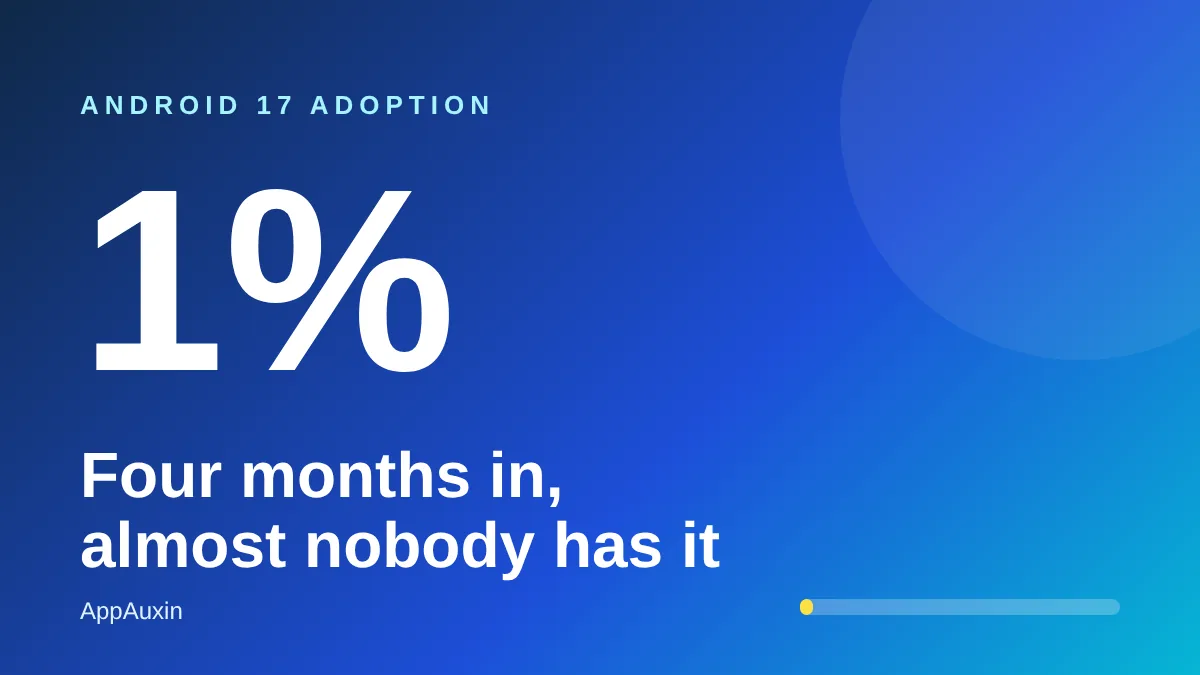
Android 17 adoption is tiny right now: about 1% of active Android devices run it, four months after it reached Pixel phones. Google’s latest distribution numbers, dated October 19, show Android 16 on 25.4% and Android 11, a 2020 release, still on 10.5%. If your phone hasn’t updated yet, you’re in the overwhelming majority.
Here are the numbers that matter at a glance.
- Android 17 share: roughly 1% of active devices (data as of October 19, 2026)
- Android 16 leads with 25.4%, followed by Android 14 at 15.3%
- Android 17 reached eligible Pixel phones in June 2026
- Samsung only started its wider Android 17 rollout in the past few weeks
- The numbers should rise quickly once Samsung updates are counted
That last point is the key to reading this story. The low figure says more about timing than about any problem with the software.
Why is Android 17 adoption so low after four months?
Google ships the new Android version to Pixels first, and everyone else follows on their own schedule. Phone makers have to port the update, test it on each model, and push it out region by region. Carrier approval adds more delay in some countries.
According to 9to5Google, the biggest names, Samsung included, only began pushing their Android 17 builds in the last few weeks. Those phones are unlikely to show up in the October 19 snapshot yet.
Pixel owners don’t escape the confusion either. Our look at why the Pixel 11 skipped Android 17 QPR1 shows that even Google’s own update cadence has surprises.
Android version distribution: where every release stands
The table below uses figures reported by Beebom from Android Studio data, as of October 19, 2026. The listed versions add up to about 88%, so the rest sits on older releases.
| Android version | Share of devices | What it tells you |
|---|---|---|
| Android 17 | 1.0% | Only just starting to reach non-Pixel phones |
| Android 16 | 25.4% | The most common version today |
| Android 15 | 14.7% | Mid-range phones from 2025 still sit here |
| Android 14 | 15.3% | Larger than Android 15, showing slow upgrades |
| Android 13 | 11.8% | Still widely used, near end of support on many brands |
| Android 12 | 9.6% | Old, and missing recent security fixes on most phones |
| Android 11 | 10.5% | A 2020 release on about one in ten devices |
The Android 16 number stands out. It was only at 7.5% in Google’s January 2026 update, so its climb to over 25% was fast, according to the same 9to5Google report. Android 17 is following a later start, not necessarily a slower path.
Will your phone get the Android 17 update soon?
It depends on the brand. Samsung’s rollout is the one that will move the Android 17 adoption chart most, since Galaxy phones make up a large slice of active devices. We cover that process in our guide to the One UI 9 update for the Galaxy S26.
Other brands are moving too. Nothing has also begun its Nothing OS 5.0 rollout, which is built on Android 17, TechRepublic reports. OnePlus owners can see how ColorOS 17 is landing in our OnePlus update breakdown.
Updates usually arrive in waves. Flagships come first, mid-range phones follow, and budget models can wait months or never get it.
How to check if your phone can update to Android 17
You don’t need to wait for a notification. A quick manual check takes about a minute.
- Open Settings, then About phone, and note your Android version and security patch date.
- Go to Settings, then System or Software update, and tap the check for updates button.
- Look at your maker’s official update page or community forum for your exact model and region.
- If nothing shows, try again in a few days, because rollouts often reach users in stages.
Why this matters: a phone that shows no update today may still be on the maker’s schedule, not abandoned.
Should you wait or push for the Android 17 update?
Wait if your phone is on a recent version and gets regular security patches. A staged rollout means early adopters often hit bugs that get fixed in a later build.
Act sooner if you’re on Android 12 or older. Those phones have gone without many security fixes, and they make up roughly one in five devices in this data. If your phone can’t update, it may be time to look at replacement options, as we explained for Pixel 6 end of support.
Frequently Asked Questions
What percentage of Android phones run Android 17?
About 1% of active devices, based on Google’s data as of October 19, 2026. That number is expected to climb as Samsung and other makers finish their rollouts.
Which Android version is most popular right now?
Android 16, at 25.4%. Android 14 comes second at 15.3%, ahead of Android 15 at 14.7%.
Why hasn’t my phone received Android 17?
Your phone maker may not have started its rollout for your model or region yet. Updates reach flagships first, and carrier approval can add delays.
Is it safe to stay on an older Android version?
It is fine for a while if your phone still gets monthly security patches. Once patches stop, which is common for Android 12 and older, you carry real risk, especially for banking and email.
The 1% figure looks alarming, but it mostly reflects a late start. Check for the update now, keep your security patches current, and don’t force a risky workaround to get Android 17 a few weeks early. If your phone is on Android 12 or older, treat the next upgrade as a safety decision, not a feature chase.
Leave a Reply