

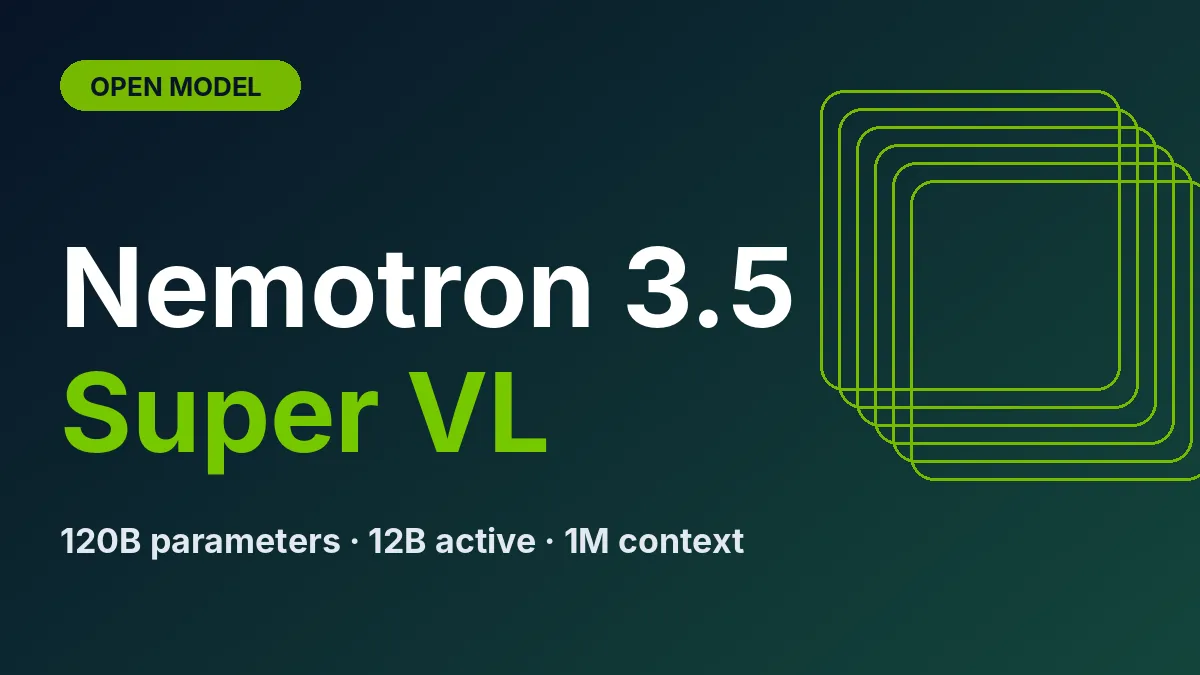
Nemotron 3.5 Super VL is Nvidia’s new open 120B model that reads text, images and short video clips, and its weights went live on Hugging Face on October 15. You can use it commercially, but you’ll need data-center-class GPUs, and Nvidia’s big benchmark wins haven’t been independently checked yet.
Here’s what matters before you download anything.
Quick Facts
These are the details most people ask about first, taken from the official Hugging Face model card.
- Released October 15, 2026 on Hugging Face (NVFP4 version 1.0).
- 120B total parameters, 12B active per token, and up to a 1M-token context window.
- Licensed under OpenMDW-1.1, which the card says allows commercial and non-commercial use.
- Listed setups: one DGX Spark, one H200, two H100s, or one GB200, all on Linux.
- Takes text, images and MP4 video up to 2 minutes. It outputs text only.
In short, it’s open and capable, but it isn’t a model for a typical home PC.
What is Nemotron 3.5 Super VL, really?
It’s a mixture-of-experts model. That means 512 small “expert” blocks sit in each layer, and only a few fire for any given token, so just 12B of the 120B parameters do work at a time.
Nvidia built it as a Mamba-2 and Transformer hybrid with a vision encoder, so it can read PDFs, charts, tables and screenshots. It’s aimed at agents that need to look at a document or web page and then act.
One catch: “12B active” speeds up each answer, but it doesn’t shrink the download. You still have to hold all 120B parameters in memory.
What you need to run Nemotron 3.5 Super VL
The model card lists only Nvidia Blackwell and Hopper hardware, and it doesn’t state a VRAM requirement. Treat that as a signal that this is built for servers and Nvidia’s own mini AI workstation, not gaming cards.
The weights ship in NVFP4, a 4-bit format Nvidia made with quantization-aware training. On Blackwell chips it runs fully in 4-bit. On older Hopper chips it uses a mixed mode.
You’ve got plenty of ways to serve it, and the card gives commands for each:
- vLLM, with a ready Docker image and an OpenAI-compatible endpoint.
- SGLang and TensorRT-LLM for higher-throughput setups.
- llama.cpp, Unsloth and Docker Model Runner for lighter experiments.
If you only have a single consumer GPU, wait for the smaller models. AI Weekly reports Nvidia also plans a 74B “Bolt” model that it says fits in 24GB, plus a 4GB edge model due October 23. Those are company claims until they ship.
Is the license really open for business use?
The weights use Nvidia’s OpenMDW license. AI Weekly says it permits commercial use, fine-tuning and redistribution, which makes it friendlier than many “open” releases.
There’s a cost angle, though. AI Weekly’s report says production use of Nvidia’s supported stack requires NVIDIA AI Enterprise at $4,500 per GPU per year. Check whether that applies to how you plan to deploy before you commit.
If you’re comparing open options, our look at Meta’s Muse Spark Open license and Mistral Large 4’s open weights shows how different these terms can be.
Do Nvidia’s benchmark claims hold up?
Partly, and only on Nvidia’s word. The model card compares the full BF16 weights with the compressed NVFP4 ones, and these numbers are vendor-reported.
| Benchmark | BF16 | NVFP4 | What it tells you |
|---|---|---|---|
| GPQA-Diamond | 89.52 | 89.90 | Basically a tie |
| LiveCodeBench v6 | 88.22 | 87.41 | Small drop |
| SWE-bench Verified | 71.10 | 71.07 | No real change |
| WebVoyager (offline) | 77.72 | 66.31 | Big drop on web-agent work |
The compression costs almost nothing on reasoning and coding. Web-agent tasks lose over 11 points, so test your own workflow before trusting the 4-bit build for browsing agents.
Nvidia also says post-trained versions beat Claude Opus 5 and GPT-6.1 Sol on five specialized tasks. AI Weekly notes Nvidia hasn’t shared task definitions, sample sizes or testing protocol, so treat those wins as unverified. If you’re curious how local AI fits into Windows, see our guide to Windows Hybrid Intelligence.
Frequently Asked Questions
Can I use Nemotron 3.5 Super VL commercially?
The model card says it’s ready for commercial or non-commercial use under OpenMDW-1.1. Read the license text and Nvidia’s enterprise terms before you ship a product.
Can I run it on a gaming PC?
Probably not. The listed setups start at one DGX Spark or one H200, and no consumer GPU configuration is given.
Does it understand images and video?
Yes. It accepts JPEG and PNG images and MP4 video up to 2 minutes, but it only answers in text.
What are the Bolt models?
They’re smaller Nvidia models, a 74B-A9B version and a 4GB edge version. The edge model is slated for October 23, so its performance is unproven.
Our take
If you run your own GPU servers and build document or web agents, Nemotron 3.5 Super VL is worth a weekend test, especially in BF16 if accuracy matters more than cost. If you’re on a laptop or a single gaming card, skip it for now and watch the Bolt releases. Either way, ignore the “beats Opus 5” headlines until someone outside Nvidia reproduces them.
Leave a Reply